Province of Nova Scotia Financial Review
Interim Report
7th August 2009
(Unofficial user-friendly HTML version)
Province of Nova Scotia
Financial Review
Interim Report
7th August, 2009
Table of contents
1. Introduction
(...page 1)
§1.1 Background
§1.2 Objectives
§1.3 Disclaimer
§1.4 Glossary
§1.5 Approach
2. Events in 2008-2009
(...page 3)
§2.1 University Assistance Grants
Table A University Assistance levels under recent MOU's
Chart 1 University Assistance 1999-2000 to 2012-2013
Table B Impact of university prepayment on operating results
§2.2 Offshore offset revenues under Section 76A (1) of the Provincial Finance Act
Table C Details of offshore offset payments
Chart 2 Reported and projected surpluses under PSAB compared to 4th May Estimates and offshore offset revenues
Table D Recalculation of 2008-2009 forecasted surplus/deficit according to Section 76A of the Provincial Finance Act
Table E Calculation of the required surplus to comply with section 76 A (1) and section 78 (1) of the Provincial Finance Act
Chart 3 Impact on Net Direct Debt when surpluses not sufficient enough to comply with of section 76 of the Provincial Finance Act
3. Fiscal years 2009-2010 to 2012-2013
(...page 9)
§3.1 Projected operating results
Table F Financial Review projections of Provincial operating results, 2009-2010 to 2012-2013
Chart 4 Projected Revenues vs. Expenses, 2009-2010 to 2012-2013
Table G Financial Review projected year over year change in revenue and expense items
§3.2 Revenues
Table H Summary of private sector economic forecasts
Table I Summary of current Government's platform commitments impacting revenue
Table J Financial Review revenue projections, 2009-2010 to 2012-2013
Chart 5 Financial Review revenue projections to 2012-2013
§3.3 Expenses
Table K Debt Servicing Costs and Pension Valuation Adjustments
Table L Revised departmental expense projections, before escalation, 2009-2010 to 2012-2013
Table M Revised departmental expense projections, including escalation, 2009-2010 to 2012-2013
Table N Financial Review expense projections, 2009-2010 to 2012-2013
§3.4 Net Direct Debt
Table O Net Direct Debt using 4th May Estimates and spending outlined under "Building for Growth"
Table P Net Direct Debt using projection of revenue and expenses (from sections 3.2 and 3.3)
Chart 6 End of year Net Direct Debt
Table Q Revenue excluded for calculation of balanced budget (per Section 76A)
Table R Surplus required under PSAB to comply with the Provincial Finance Act
4. Conclusion
(...page 21)
Accounting
Financial Management
Other observations
Appendix A – Additional review items
(...page 23)
§A.1 Offshore petroleum royalties
Analysis Henry Hub natural gas spot price
Chart A.1 Petroleum Royalties 2000 to 2020
Chart A.2 Offshore petroleum royalties as a percentage of total provincial revenues
§A.2 Federal transfer (equalization) payments
Chart A.3 Equalization payment revenues
§A.3 Intergovernmental agreements
Table A.A Summary of Nova Scotia Intergovernmental Agreements with Federal Government
§A.4 Provisions for losses and/or bad debts
Appendix B – Relevant Sections of the Provincial Finance Act
(...page 29)
Appendix C – Definitions of accounting terms and treatments relevant to the Financial Review
(...page 32)
§C.1 Accounting treatments
§C.2 Definitions
Appendix D – Glossary
(...page 34)
Page 1
1. Introduction
This document is the interim report to the Government of Nova Scotia under Phase 1 of the two-phase Financial Review project.
1.1 Background
The people of Nova Scotia elected a new Government on 9th June 2009, and the newly appointed Executive Council was sworn in on 19th June, 2009. During the election campaign the new Government committed to an immediate review of the Province's finances upon entering office.
Deloitte & Touche LLP ("Deloitte") has been contracted to assist the new Government of Nova Scotia with an independent review and analysis of the Province of Nova Scotia's current and future financial position. The review will provide financial information for Government to use in making decisions about the overall management of Government programs. This will assist the Government in meeting its program and fiscal objectives.
1.2 Objectives
The objectives of Phase 1 are to review, analyze and report on whether the revenue and expense estimates, and the resulting operating surplus or deficit in the 2009-2010 estimates, presented to the Legislature on 4th May 2009 were:
- in accordance with legislation; and
- in accordance with the Public Sector Accounting Board's1 ("PSAB's") generally accepted accounting principles for Canadian governments ("GAAP"2).
The Government has asked Deloitte to ensure that specific items are given particular focus. These items will be identified throughout the report, together with the specific request the Government has made with respect to each item. The specific items, as found in the Government's 'Request for Proposal' for this Financial Review, are:
- the economic assumptions underlying the 4th May 2009 Budget, changes in economic indicators since tabling of the Budget, and impact on revenue forecasts (section 3.2);
- the rationale for allocation of university assistance expenses by fiscal year3 and the impact on the Province's surplus/deficit for 2008-2009 and estimates for 2009-2010 (section 2.1);
- the impact on the operating surplus/deficit and net debt for the period from 2005-2006 to 2012-2013 of Offshore Revenues under Section 76 (1) of the Provincial Finance Act (section 2.2);
- the impact of the proposed "Building for Growth – Nova Scotia's Infrastructure Plan" ('Building for Growth') on expenditures and net debt from 2009-2010 to 2012-2013 (section 3.4);
Table of Contents
Page 2
- Nova Scotia's future obligations to 2012-2013 under intergovernmental agreements and programs (Appendix A, A.3);
- provisions for losses and or bad debts recorded by Government departments, agencies and funds as of 31st March 2009 (Appendix A, A.4);
- Nova Scotia's obligations under public sector pension plans and the estimated impact on expenses for the years 2009-2010 to 2012-2013 (section 3.3);
- medium term revenue forecasts to 2012-2013 (section 3.2) including Federal transfer payments (Appendix A, A.2) and offshore
petroleum royalties (Appendix A, A.1
);
- expenditure forecasts to 2012-2013 using status quo assumptions (i.e. no new programs or policy changes) (section 3.3); and
- all
outstanding, unfulfilled, verifiable commitments for capital spending made on behalf of the outgoing Government to communities and organizations, and recommend how these should be reported in the Province's financial statements according to PSAB standards (section 3.4).
These items are referenced to the relevant sections of the document where a concluding comment is made.
1.3 Disclaimer
Consistent with expectations of the Government, Deloitte conducted a financial review, not an audit, of certain specified aspects of the Province of Nova Scotia's financial situation. The Auditor General of Nova Scotia is responsible for auditing the financial statements of the Province of Nova Scotia and the review of the revenue estimates in the budget.
1.4 Glossary
A glossary containing some relevant terms used throughout this report can be found in Appendix D.
1.5 Approach
Our review procedures have consisted primarily of interviews, discussions, review of documents, and analysis.
Deloitte relied on officials within the Government of Nova Scotia to establish a view on the Province's financial position. We have reviewed and analyzed information asked of, and provided to us by, provincial officials, looking at multiple sources, where possible, in order to ensure consistency and completeness. We have not conducted a verification process with respect to expense or revenue projections for individual Departments and Programs.
Good financial management practices extend beyond good accounting practice to support areas such as multiyear planning and budgeting, costbenefit decisions around investments, riskranked prioritization for investments, and pay back calculations that include value to the citizen, as examples. Throughout this report, where appropriate, we comment on strong and preferred financial management practices for governments, in addition to our findings on adherence to the Provincial Finance Act (for relevant excerpts of the Act see Appendix B) and the appropriateness of accounting treatments (for summarized findings on accounting treatments see Appendix C).
Table of Contents
Page 3
2. Events in 2008-2009
When the 2009-2010 Estimates were presented to the Legislature on the 4th of May 2009, there were two items in 2008-2009 that had an important impact on the financial results used as a base in the 2009-2010 Estimates and the multiple years' projections. Prior to addressing the Province's 2009-2010 projections from the 4th May Estimates, this section reviews two items which most significantly influenced the 2008-2009 operating results; University Assistance (see section 2.1), and the impact of Offshore Offset Revenues under Section 76A of the Provincial Finance Act (see section 2.2). These items impact fiscal year 2009-2010 and subsequent fiscal years.
2.1 University Assistance Grants
The Province's surplus/deficit for 2008-2009 and estimates for 2009-2010 were impacted by university assistance payments made in advance of the fiscal year in which they were to be used. Below is the analysis of the allocation of university assistance expenses by fiscal year.
Background
Under the Universities Assistance Act, the Minister of Education may, to the extent authorized by legislation, make grants to assist universities in defraying operating expenses and expenses for capital purposes. Of late, the amount of assistance has been laid out in agreed 'Memorandums of Understanding' (MOU's) between the Province and the universities. Three MOU's have been negotiated to date:
- '2004 MOU' signed 7th December 2004 to cover four fiscal years (2004-2005 to 2007-2008)
- '2008 MOU' – signed 31st March 2008 to cover three fiscal years (2008-2009 to 2010-2011)
- '2009 MOU' – signed 30th March 2009 to cover three fiscal years (2008-2009 to 2010-2011)
Note that the '2009 MOU' supersedes the '2008 MOU' as it covers the same period of time.
The 30th March 2009 MOU reflects the Government's decision to prepay a portion of the previously agreed 2009-2010 assistance in fiscal year 2008-2009. Accordingly, on 31st of March 2009, the Minister of Finance announced4 that an additional appropriation of $256 million had been approved, which would have the effect of reducing the Province's 2008-2009 budgeted surplus. We note that at the same time, the 2009-2010 assistance estimate was lowered to $63 million to reflect the advance payment in 2008-2009.
Impact of the 2009 MOU on University Assistance payments
Table A shows the change in university assistance amounts following the signing of the '2009 MOU'.
Table of Contents
Page 4
Table A: University Assistance levels under recent MOU's
| Table A |
($ millions) |
University
assistance |
2008-
2009 |
2009-
2010 |
Total assistance
(2 years) |
| '2008 MOU' |
216 |
319 |
535 |
| '2009 MOU' |
472 |
63 |
535 |
The graph below illustrates the impact of the prepayment by comparing the actual assistance provided to Universities (squares on graph), to the '2009 MOU' (triangles on graph), and to the 4th May Estimates (diamonds on graph). Essentially there is a dramatic interruption in the normal trend of university spending due to the prepayment (see triangles on graph).
Chart 1: University Assistance 1999-2000 to 2012-2013

*In 2010-2011 and beyond, it is anticipated that assistance continues at same level of increases as negotiated in past MOU's (approximately $30million per year).
The estimates and actual payments would normally be expected to equal the MOU; however the advance payment of $256 million was not budgeted in 2008-2009 as it was not part of the original MOU signed in 2008.
The assistance estimate in 2009-2010 of $62.7 million thus needs to increase to $348.7 million in 2010-2011 in order to satisfy the MOU and resume the normal appropriations, which means a one year increase in 2010-2011 of $288 million.
The lower estimated grant payments in 2009-2010 creates budgetary pressures in subsequent years in order to return to conventional levels of annual assistance. The prepayment in 2008-2009 created a temporary reprieve on University expenses for 2009-2010.
Table of Contents
Page 5
Impact of advance payment on the Province's Surplus/Deficit for 2008-2009 and estimates for 2009-2010
The below summary illustrates the impact of the advance payment on the forecasted surpluses for 2008-2009 and 2009-2010. If payments were made per the original '2008 MOU', as outlined in Table B, a $278.3 million surplus would have resulted in 2008-2009, all other things remaining equal. In addition, a $252 million deficit would have resulted in 2009-2010.
Table B: Impact of university prepayment on operating results
| Table B |
($ millions) |
| Description |
2008-2009
Forecast |
2009-2010
Projection |
|
Provincial Surplus/Deficit 1 |
22 |
4 |
|
Add back: advance payment to 2009-2010 |
– |
-256 |
|
Remove: 2009-2010 advance payment |
256 |
–
|
| Adjusted Surplus/Deficit |
278
|
252
|
1 Reported per the 4th May Fiscal Plan, 2009-2010 to 2012-2013
Rationale for allocation of university expenses by fiscal year
A prudent financial management practice for recurring assistance payments, like those made to universities under the MOU, would be to avoid one time or prepayments. Once such a pattern is broken, new financial planning is required to resume the recurring expenditure in the multiyear forecasts. The rationale for avoiding one time or advance payments, is to match grants to the year in which expenses are incurred by universities, which would:
- simplify the Government's budgeting process in this area and avoid volatility in grant payments (see Chart 1);
- improve year over year expense comparisons; and
- prevent potential cash flow/expense management issues for recipient
institutions of receiving large sums of money in one lump sum payment.
The accounting treatment for the advance payment in 2008-2009, however, complies with GAAP, subject to the Auditor General performing his audit.
2.2 Offshore offset revenues under Section 76A (1) of the Provincial Finance Act
This section discusses the impact on the operating surplus/deficit and net debt for the period from 2005-2006 to 2012-2013 of Offshore Offset Revenues under Section 76A (1) of the Provincial Finance Act.
See Appendix B for further detail on relevant sections of the Provincial Finance Act.
Offshore offset revenues explained
Offshore offset revenues, in the context of the Provincial Finance Act, are not royalties related to offshore petroleum, but the result of an agreement with the Federal Government to compensate the Province for the negative impact on equalization payments, since offshore royalty revenues are included in the equalization calculation.
Table of Contents
Page 6
Background
In July 2005, the Province of Nova Scotia received a payment of $830 million from the Government of Canada, under the Offshore Accord (the "Agreement"). This payment, covering an eight year period, was compensation for lower than anticipated equalization revenues due to the inclusion of the offshore petroleum royalty in provincial revenues. The payment represented the estimated value of the sum of annual revenues within the eight year agreement.
The Province used the $830 million in the 2005-2006 fiscal year, the year it was received, to retire outstanding debt. However, accounting rules, under PSAB, do not permit the entire $830 million (representing eight years of income) to be recognized as revenue on the Province's financial statements in one fiscal year. To conform with PSAB, the revenue is deferred and recorded in the Province's financial statements over the eight year life of the agreement. At the outset of the agreement, estimates were made of the annual amounts that would likely be recognized as revenue, as noted in Table C (below).
The Financial Measures Act (2005) enacted changes to the Provincial Finance Act to ensure that surpluses over the eight year period ending in 2011-2012 would be at least equal to the amount of annual revenue recognized under GAAP from the amortization5 of the $830 million offshore offset payments. The legislation was designed to ensure the $830 million reduction in debt was not reborrowed to fund new expenses.
The amendments to the Provincial Finance Act established Section 76A to ensure that, in effect, the offshore offset revenues were not permitted to be included as revenues for the purposes of balancing the budget, as the money had already been used to pay down the Provincial debt. Thus the actual minimum surplus, under PSAB, that the Government is required to deliver each year is the lesser of the annual offshore offset revenue amount calculated each year and the amounts specified in Section 76A. Over the first four years of the offshore offset payment period, actual revenues were less than the amounts estimated at the onset per Table C. See the actual offshore royalties plotted on Chart 2.
Table C: Details of offshore offset payments
| Table C |
($ millions) |
| Description |
2005-
2006* |
2006-
2007 |
2007-
2008 |
2008-
2009 |
2009-
2010 |
2010-
2011 |
2011-
2012 |
Total |
| Payment received |
830 |
– |
– |
– |
– |
– |
– |
830 |
Estimated annual
Revenues from
Offshore royalties
under PSAB
as required by
Section 76A |
57 |
93 |
189 |
207 |
151 |
92 |
41 |
830 |
Actual/Projected
Revenues
(recognized in
accordance with
PSAB) |
57 |
57 |
68 |
106 |
180 |
215 |
147 |
830 |
*includes revenues from 2004-2005 as agreement was backdated to cover revenues in 2004-2005 fiscal year
The following chart illustrates the Province's reported surpluses over the past four years, together with its projected surpluses per the 4th May Estimates, plotted against the minimum surplus required each year under Section 76A.
Table of Contents
Page 7
Chart 2: Reported and projected surpluses under PSAB compared to 4th May Estimates and offshore offset revenues

For years up to and including 2009-2010, the actual amount of offshore offset revenue was less than anticipated under Section 76A. Under Section 76A, the amount of revenue recognized each year is not to exceed the original estimates set out in Table C above, but may differ from year to year. This is due to the fact that revenues are calculated annually, using GAAP, and are based upon the price and volume of petroleum during the course of the year. However, the total amount at the end of eight years must equal $830 million. As a result you see "catch up" amounts calculated for the 8th year, 2011-2012.
Impact under the Provincial Finance Act
The forecast surplus of $22.3 million in the 2008-2009 fiscal year is in
accordance with PSAB. However it does conflict with Sections 76A (1)(d), 76, and 78(1) of the Provincial Finance Act, as a surplus equivalent to the offshore offset amount (per Table C) was not provided for.
As defined by the Provincial Finance Act, a surplus of $105.9 million was
needed in order for a budget to be balanced as defined by 76A (1) (d); see Table D below.
Table D: Recalculation of 2008-2009 forecasted surplus/deficit according to Section 76A of the Provincial Finance Act
| Table D |
($ millions) |
| Description |
2008-2009 |
Forecasted Surplus
(per 4th May Estimates) |
22 |
Less: Revenue that cannot
be counted against
balanced budget |
106 |
| Deficit under Section 76A |
(84)
|
Under Section 76 of the Provincial Finance Act, a deficit must be recovered in the subsequent fiscal year. Accordingly, since a deficit of $84 million resulted in 2008-2009 according to the Provincial Finance Act (per Table D), a $235 million surplus is necessary in 2009-2010 to comply with the Provincial Finance Act as illustrated in Table E below. Surpluses are also required in subsequent years to comply with the Act.
Table of Contents
Page 8
Table E: Calculation of the required surplus to comply with section 76 A (1) and section 78 (1) of the Provincial Finance Act
| Table E |
($ millions) |
| Description |
2009-
2010 |
2010-
2011 |
2011-
2012 |
|
Recovery of prior year's deficit |
84 |
– |
– |
Offshore Offset Revenue that cannot
be counted as revenues against a
balanced budget |
151 |
92 |
298 |
Required surplus under PSAB
to comply with
Section 76A (1) and 78 (1) |
235
|
92
|
298
|
Per Table E, the amount of offshore offset revenues to be recognized in 2011-2012 is particularly high as lower levels of actual offset revenues in prior years must be 'caught up' to capture the remainder, or balance, of the $830 million by Year 8. Further, the budget for 2011-2012 requires a surplus, under PSAB, of almost $300 million according to Section 76 A (1).
Impact on Net Direct Debt when surpluses not sufficient to comply with the Provincial Finance Act (including the impact of capital expenditures under "Building for Growth")
As discussed previously, Section 76A of the Provincial Finance Act anticipates, and requires, that the surplus each year will at least equal the amount of Offshore Offset revenue for that year, up to the maximums set out in the Act. The 4th May Estimates for the 2008-2009 and 2009-2010 fiscal years set out operating results that are below what is required under Section 76A. As a result, the impact on Net Direct Debt of not complying with Section 76 A of the Provincial Finance Act is an unfavorable difference of approximately $600 million in four years time as illustrated in the graph below.
Chart 3: Impact on Net Direct Debt when surpluses not sufficient enough to comply with of section 76 of the Provincial Finance Act
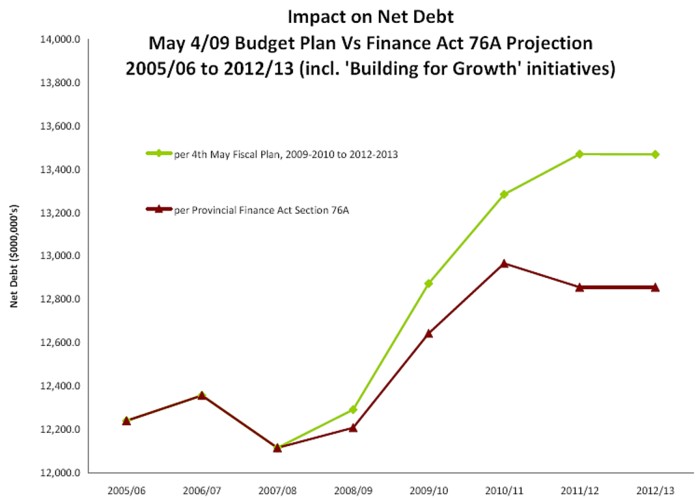
In 2012-2013, adhering to the Offshore Offset revenue amounts in Section 76A, it is anticipated that the Net Direct Debt will total $12.8 billion. The mounting net debt is largely the result of capital spending initiatives. However, the 4th May estimates and 2008-2009 actual results set in motion a Net Direct Debt at March 31, 2013 of $13.4 billion.
Table of Contents
Page 9
3. Fiscal years 2009-2010 to 2012-2013
The four-year projection, set out below, that the Government must manage is a challenging one due to the combined impact of historic decisions, changes in economic indicators, and continued cost pressures that are typical with the demographic trends that accompany an aging population. Each of these issues present financial management challenges for the next four years. We present these challenges under the following headings: operating results (section 3.1) and the related revenue (section 3.2), expense (section 3.3) net debt trends, and "Building for Growth" (section 3.4).
3.1 Projected operating results
Using the updated Revenue and Expense figures from Table J and Table N (found later in this report), the projected annual Operating Results of this Financial Review are as follows.
Table F: Financial Review projections of Provincial operating results, 2009-2010 to 2012-2013
| Table F |
($ millions) |
| Description |
2009-
2010 |
2010-
2011 |
2011-
2012 |
2012-
2013 |
| Revenues |
8,462 |
8,397 |
8,559 |
8,835 |
| Expenses |
8,513 |
9,113 |
9,634 |
10,136 |
| Deficit |
-51
|
-716
|
-1,075
|
-1,301
|
Flat revenue growth and a reasonable allowance for inflation of expenses result in operating shortfalls into the future.
The combination of several events has culminated in the projected trend of future deficits, led primarily by the growth in expenses which is expected to outpace revenue growth, under status quo assumptions, into and past 2012-2013. The resulting deficits are more complex than normal cyclical deficits and more complicated than typical structural deficits6 would suggest.
Nova Scotia is facing a projected annual deficit of $1.3 billion by 2012-2013 due to:
- The completion of a period of extraordinary revenue growth which was dependent to date on nonrepeatable items such as offshore petroleum royalties, offshore license forfeitures, and atypical agreements with the Federal Government (i.e. transitional equalization payments per Appendix A, A.2, offshore offset payments per section 2.2).
- Expense growth, that has matched the Province's extraordinary revenue growth, tends to be for recurring programs that are difficult to stop or curtail. Expense growth is projected to continue, although at a slower rate than in the past (section 3.3).
- Revenue projections into the future are impacted by further extraordinary items that create a projected decrease of revenue, due largely to the economic downturn, with only mild growth returning in 2011-2012 and 2012-2013.
Table of Contents
Page 10
- Consistent with all governments in Canada, Nova Scotia's expense growth is escalating as governments address the demographic pressures of an aging population. The following Chart shows the projected impact of the above items to 2012-2013.
Chart 4: Projected Revenues vs. Expenses, 2009-2010 to 2012-2013

The increase in the projected deficit can be further explained by the following table:
Table G: Financial Review projected year over year change in revenue and expense items
| Table G |
($ millions) |
Year over year changes
in operating results
due to changes in: |
2010-
2011 |
2011-
2012 |
2012-
2013 |
Revenues (including Net
Income from Government
Business Enterprises) |
65 |
-162 |
-276 |
| Departmental expenses |
462 |
378 |
371 |
| Consolidation Adjustment |
44 |
38 |
– |
| Debt Servicing Costs |
64 |
66 |
84 |
| Pension Valuation Adjustment |
30 |
39 |
47 |
| Increases in Deficit |
665
|
359
|
226
|
A discussion on the impact of the Provincial Finance Act on the above deficit projections can be found on section 3.4.
Summary
Like other governments in Canada, and abroad, Nova Scotia faces steadily escalating costs. In the past, Nova Scotia was able to keep the revenue growth in line with expense escalation due to various unique, shortterm, revenue sources. In 2007-2008 Nova Scotia began to see a decline in unique revenue sources, like the offshore petroleum revenues which are now expiring, together with a negative impact on equalization payments, which will be fully realized in 2010. The overall result is a relatively flat revenue trend for a six year period. These conflicting cost and revenue pressures are creating the single largest financial management challenge for the Nova Scotia Government for the decade ahead. Nova Scotia must not only address the cost pressures all Canadian governments are
Table of Contents
Page 11
facing, but it must also address the expiry of shortterm revenue sources that it has become dependent on.
3.2 Revenues
In this section, medium term revenue forecasts to 2012-2013 are presented. In sections 1 and 2 of Appendix A we provide further, detailed, commentary on two specific components of our revenue forecasts; offshore petroleum revenues and federal equalization payments.
In order to understand the revenue projections for the Province, we
compare revenues from the 4th May Estimates to revenues in light of:
- Changes to economic indicators post 4th May Estimates.
- New Government platform commitments (announced in 'Better Deal 2009').
Changes to economic indicators
Private sector forecasts for Nova Scotia Real Gross Domestic Product (GDP) growth have worsened in the past four months, since the March 2009 forecasts used in the 4th May Estimates. Changes in the 2009 GDP forecasts and other economic indicators are significant enough at this midyear point that they result in decreases in the revenue projections for the medium term. In 2009-2010 a $50 million decrease in revenues is projected versus the previous year; 2010-2011, $65 million versus previous year. Projected revenues are not anticipatedto increase until 2011-2012 (per Chart 5).
The following table illustrates the changing consensus opinion of private sector forecasters since the 4th May Estimates were published by the Province.
Table H: Summary of private sector economic forecasts
| Table H |
% increase
in real GDP |
Forecast -
March 2009
(used in 4th May
Estimates) |
Forecast -
June 2009 |
| High |
0.8% |
0.4% |
| Average |
(0.3%) |
(0.7%) |
| Low |
(1.7%) |
(2.0%) |
The average consensus of private sector economists in March indicated a contraction in GDP of 0.3% for calendar year 2009, with an estimated contraction in GDP of 1.7% at the lower end of the range. In contrast, the Province chose to include a growth in GDP assumption, of 0.2% in its 4th May Estimates. As such the GDP assumption used to forecast revenue in the 4th May Estimates was higher than the average private sector economists' estimates.
While some small change is noted in the June economic forecasts related to the future years, various risks continue to exist around revenues that could further limit revenue growth potential:
- Lower investments in 2009;
- Continued weakness in commodity prices which strongly influence Nova Scotia's revenues;
- The Province's aging population, specifically through:
– The potential for staff turnover/early retirement;
– Reduced pension values which may translate to reduced spending from seniors;
– The increased mix of seniors in a population will lead to lower consumer spending; and
– The increased use of defined contribution pension plans.
- Potential increases in unemployment in Nova Scotia;
- Historic dependency on public sector to support growth in employment rates;
- Business services and financial services continue to present a risk;
- Current infrastructure profits will wrap up and new projects
may be subject to delay;
- Decreased US sales and housing starts and strong Canadian decrease export opportunities;
Table of Contents
Page 12
- Federal Government deficits will lead to lower transfer payments and negative impacts to
equalization payments;
- Nominal GDP is subject to deflation; and
- Continued depreciation persists in European currencies.
The revenue projections of this Financial Review, and resulting forecasted operating results, have included these risks in the economic forecasts in the future years, only to the best of the knowledge of the private sector economists at the time of this report's publication. Any softening in these risks can further and adversely impact the revenue projections.
Because of the regular changes in the indicators that impact the revenue assumptions, the Province updates revenues periodically to reflect more current information, data, and assumptions. The Province uses various sources of information to update revenue forecasts and projections including:
- Privatesector economic forecasts;
- Department of Finance economic forecasts;
- Federal Government information particularly on Equalization and income tax;
- Monitoring of petroleum production, prices and related data for estimating royalty revenue; and
- Provincial consumption data (e.g. tobacco and fuel).
Per the Department of Finance's latest forecasts, total revenue is expected to increase over the entire eight year period of 2004-2005 to 2012-2013. However, within this period revenues are expected to fall over the next three fiscal years. This trend does reverse in 2011-2012 and 2012-2013, but revenues actually fall below 2008-2009 levels in 2009-2010 and 2010-2011.
New Government platform commitments impacting revenue
The new Government has made commitments during the election, and through announcements since taking office, that impact revenue. The following table reflects how these commitments will impact revenue in each of the next four years.
Table I: Summary of current Government's platform commitments impacting revenue*
| Table I |
($ millions) |
| Commitment Item |
2009-
2010 |
2010-
2011 |
2011-
2012 |
2012-
2013 |
| HST housing rebate |
-11 |
– |
– |
– |
| Equity tax credit boost |
-1 |
-1 |
-1 |
-1 |
| Student incentives |
– |
-6 |
-6 |
-6 |
| HST electricity rebate |
-14 |
-28 |
-28 |
-28 |
| Increase renewable energy |
– |
– |
– |
3 |
| Total impact |
-26
|
-35
|
-35
|
-32
|
*Source: "Better Deal 2009"
The amounts in the above Table I have been taken directly from the election platform document "Better Deal 2009". The timing of implementation of the HST rebate on electricity reflects an announcement by the new Government that the rebate is expected to be implemented October 1, 2009. The amount shown represents one half (six months) of the amount estimated in the platform document which indicates implementation would begin in 2010. No further analysis of the above commitments has been performed.
Summary of Financial Review revenue forecasts
Revenue projections for the next four years, calculated by adjusting 4th May Estimates using the above mentioned information, are as follows:
Table of Contents
Page 13
Table J: Financial Review revenue projections, 2009-2010 to 2012-2013
| Table J |
($ millions) |
| Description |
2009-
2010 |
2010-
2011 |
2011-
2012 |
2012-
2013 |
Revenues, per May 4 Estimates
and Fiscal Plan |
8,537 |
8,566 |
8,706 |
9,007 |
| Net changes: |
Adjustment due to updated economic
data post 4th May Estimates |
-49 |
-134 |
-112 |
-140 |
New Government commitments
impacting revenue |
-26 |
-35 |
-35 |
-32 |
Financial Review projection,
revenues |
8,462
|
8,397
|
8,559
|
8,835
|
Chart 5: Financial Review revenue projections to 2012-2013
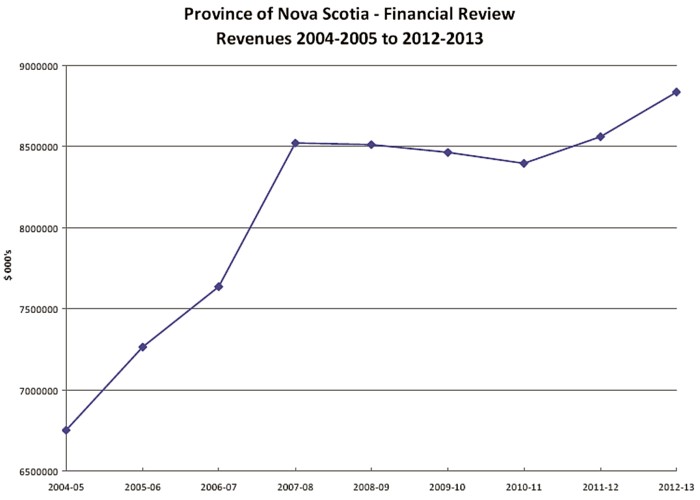
Economic indicators and the revenue estimates flowing from them are constantly changing. Since the fall of 2008, this volatility has increased as a result of the economic crisis. These projections are valid for the purposes of our report however; the new Government's budget, expected in the fall of 2009, will have revenue projections that will quite likely differ from our report. This is to be expected due to further changes in economic conditions and with updated economic data. The Auditor General will also be examining revenues, and the assumptions upon which they are based, sufficient to express an opinion on the reasonableness of the revenues that will be included in the 2009-2010 Budget.
Summary
Revenue growth is expected to remain flat until 2011-2012. As a result of various external factors, changes in the economy, offshore petroleum royalties, and equalization payments, the revenue growth is not expected to return to pre-2007-2008 levels. This has also been impacted by an aging
Table of Contents
Page 14
population, no known unique (new) revenue sources and slowed postrecessions activity. The revenue trends create a significant imperative to manage expenses in the current and future years, contributing to a challenging financial management situation for the Province of Nova Scotia.
3.3 Expenses
Expense forecasts are presented to 2012-2013 using status quo assumptions (i.e. no new programs or policy changes).
Method of analysis
Our analysis explores three main expense areas of the Government spending that impact changes in expense levels:
- Debt Servicing costs (Table K);
- Pension Valuation Adjustment (Table K); and
- Departmental spending (Table L).
Debt Servicing Costs and Pension Valuation Adjustments
We obtained the projections of expenses for Debt Servicing and the Pension Valuation Adjustment from the Department of Finance. These projections were the same as the figures prepared and used in the 4th May Estimates and are listed below in Table K.
Table K: Debt Servicing Costs and Pension Valuation Adjustments
| Table K |
($ millions) |
| Description |
2009-
2010 |
2010-
2011 |
2011-
2012 |
2012-
2013 |
| Debt Servicing Costs |
903 |
967 |
1,033 |
1,116 |
| Pension Valuation Adjustments |
82 |
112 |
151 |
198 |
The Province's Pension liability is projected to increase over four years from $82 million in 2009-2010 to $198 million in 2012-13. The Public Service Superannuation Plan (PSSP) amounts to approximately 75% of the Province's pension obligations. The interest cost related to the Province's unfunded pension liabilities is estimated to almost double over the same four year period.
Departmental expenses
The expenses in the 4th May
Estimates are supported by "Budget Targets" issued to every department. The Targets begin with an expense base for 2009-2010, which is adjusted for various approvals based on known information and approvals (i.e. remove costs when programs are scheduled to end, add target increases for known expense increases, etc.).
The Fiscal Plan released with the 4th May Estimates did not use the departmental projections ('Budget Targets') described above. Instead the Fiscal Plan put forward the level of departmental expenses required to achieve the desired surplus in each of the next four years. Commentary accompanying the Fiscal Plan explains that the Fiscal Plan is "based on the current forecast for economic growth, existing legislated structures for revenues, and the policy commitment that the budget will remain balanced. Under this scenario, spending will have to be contained largely at existing levels over the four-year period: this is in contrast to previous years when spending grew at an average annual rate of approximately 5 per
cent." Accordingly, the projection of expenses found within this report will use the more realistic 'Budget Targets' at the beginning of the year as a starting point for departmental projections, with adjustments for the following factors:
1. Known adjustments to departmental targets.
2. Include the impact of the new Government's expenditure management review as outlined in 'Better Deal 2009'.
3. Include the impact of other new Government commitments as outlined under 'Better Deal 2009'.
Table of Contents
Page 15
4. An adjustment to future years for changes in price (inflation) as our
analysis concluded that the 'Budget Target's contained no allowance for
inflation. In order to develop a realistic picture of future expenses,
some provision should be made for cost increases to existing programs.
Included in the Budget Targets and subsequent adjustments to the Targets is a provision for costs related to wage settlements and business process reengineering. Wage increases are estimated for collective agreements under negotiation, or expiring, before 2012-2013. Once contracts are ratified, adjustments are made to departmental targets. Wage settlements resulting from collective agreements are the subject of negotiations and must be approved by union members. There is always the uncertainty that the outcome of the negotiations results in a settlement that is different from what has been provided for in the Budget Targets.
Prior to applying any such escalation factors, changes resulting from the previously itemized areas were applied to the existing Budget Targets:
Table L: Revised departmental expense projections, before escalation, 2009-2010 to 2012-2013
| Table L |
($ millions) |
| Description |
2009-
2010 |
2010-
2011 |
2011-
2012 |
2012-
2013 |
| Expense base, beginning of year |
7,661 |
7,641 |
8,103 |
8,482 |
| Target adjustments (1) |
6 |
291 |
181 |
165 |
| "Better Deal 2009" Commitments (2) |
– |
18 |
8 |
4 |
| Expenditure management review (3) |
-26 |
-39 |
-8 |
-1 |
| Changes to budget base |
-20 |
270 |
181 |
168 |
Fiscal review projected
departmental expenses
before escalation, end of year |
7,641
|
7,911
|
8,284
|
8,650
|
(1) Net amount of adjustments to departmental targets each year.
(i) 2009-2010 includes $8 million for election expenses offset by a $2 million saving from a difference in the timing of the employer portion increase in contributions to the Public Service Superannuation Plan.
(ii) 2010-2011 includes increasing university assistance payments to the level required by the MOU but is offset by other departmental Budget Target items, resulting in a new increase of $90 million.
(2) Commitments of the new Government are taken directly from the document "Better Deal 2009".
(3) The Expenditure Management Review from "Better Deal 2009" projected a savings of up to 1% of total departmental spending. For planning purposes, the savings from the Review have been projected to occur in the same amounts as increases in expenses and changes in revenues occur as a result of other commitments from "Better Deal 2009".
The following items within departmental expenses are subject to increases due to price changes or inflation in the future:
- Grants and subsidies;
- Operating goods and services; and
- Professional services.
Expense patterns for the past four years 2004-2005 to 2008-2009 were analyzed to arrive at an appropriate escalation factor for future years. Expenses in this period increased between 6.2% and 8.9% annually. These rates of increase include additional new programs and other program changes which complicate the year on year comparisons. To account for the impact of inflation or price increases, an escalation factor of 5% was selected for our analysis, as outlined in Table M.
Table of Contents
Page 16
The following table is the result of applying the 5% escalation factor.
Table M: Revised departmental expense projections, including escalation, 2009-2010 to 2012-2013
| Table M |
($ millions) |
| Description |
2009-
2010 |
2010-
2011 |
2011-
2012 |
2012-
2013 |
| Expense base, beginning of year |
7,661 |
7,641 |
8,103 |
8,482 |
| Changes to Budget base |
-20 |
270 |
181 |
168 |
| Expense escalation at 5% |
– |
192 |
197 |
204 |
Fiscal Review Projected
Departmental Expenses
escalated at 5%, end of year |
7,641
|
8,103
|
8,481
|
8,853
|
Total Expenses
The below table provides a summary of our projected expenses as discussed in the previous sections.
Table N: Financial Review expense projections, 2009-2010 to 2012-2013
| Table N |
($ millions) |
| Description |
2009-
2010 |
2010-
2011 |
2011-
2012 |
2012-
2013 |
ProjectedDepartmental Expenses
escalated at 5% |
7,641 |
8,103 |
8,481 |
8,853 |
| Consolidation Adjustments |
-113 |
-69 |
-31 |
-31 |
| Debt Servicing Costs |
903 |
967 |
1,033 |
1,116 |
| Pension Valuation Adjustment |
82 |
112 |
151 |
198 |
| Projected Expenses |
8,513
|
9,113
|
9,634
|
10,136
|
Updated expense forecasts indicate a realistic expectation that expenses for 2012-2013 will be $10.1 billion as compared to the $8.9 billion included in the Fiscal Plan in the 4th May.
3.4 Net Direct Debt
The section will discuss the impact of the proposed "Building for Growth – Nova Scotia's Infrastructure Plan", on expenses and net direct debt from 2009-2010 to 2012-2013.
Background
The Province's Debt Reduction Plan 2005 provides a reasonably clear explanation of net direct debt:
"Net direct debt is defined as total liabilities less financial assets.
it is an accounting term, equal to the accumulated amount of accounting deficits or surpluses for each year, plus the investment in capital assets less amortization (the difference between these two is called the change in net book value), plus or minus changes in inventories and prepaid expenses.
In order for the net direct debt of the Province to decrease, the total surplus must be greater than the change in net book value of assets."
PSAB guidelines refer to this item as net debt. All other Canadian provinces follow PSAB's guidance and refer to total liabilities less financial assets as net debt; however, Nova Scotia includes the amended term 'net direct debt' in its financial statements instead. We understand that the Province may be reviewing this terminology but we will continue to use the existing term, net direct debt, for the purposes of this report.
Table of Contents
Page 17
Net direct debt is an important measure of a Government's long term financial position. It provides a measure of the future revenues required to pay for past transactions and events, and can give an indication of the affordability of additional spending.
An increase in net direct debt is not necessarily bad, depending on which component of net direct debt is increasing, but it might indicate that the Government's flexibility and spending room to provide future services is being impaired.
Projection of Net Direct Debt
In order to make a projection of the Province's net direct debt, estimates are required of the projected operating results for the year (because a deficit will add to the overall net direct debt), the costs of capital asset acquisitions and the anticipated amortization for existing capital assets and those to be acquired.
Projection of Net Direct Debt – 4th May Estimates
The 4th May Estimate papers included a four year Fiscal Plan which projected operating results. The Province also released "Building for Growth", a capital spending plan, which included additional stimulus spending. Using information from the May 4 Budget Bulletin on Capital Spending, the Province's net direct debt would be projected as follows:
Table O: Net Direct Debt using 4th May Estimates and spending outlined under "Building for Growth"
| Table O |
($ millions) |
Description (all figures
per 4th May Estimates) |
2009-
2010 |
2010-
2011 |
2011-
2012 |
2012-
2013 |
| Net Direct Debt, beginning of year |
12,291 |
12,873 |
13,284 |
13,469 |
| Deduct: Operating surpluses |
-4 |
-4 |
-4 |
-133 |
| Add: Acquisition of capital assets |
806 |
645 |
429 |
377 |
| Deduct: Amortization |
-220 |
-230 |
-240 |
-245 |
| Net Direct Debt, end of year |
12,873
|
13,284
|
13,469
|
13,468
|
Assuming the operating results presented in the 4th May Estimates could be achieved and the capital spending occurs as outlined in "Building for Growth", the net direct debt would increase by $1,177.2 million over four years to $13,468.3 million in 2012-2013.
Projection of Net Direct Debt – Using status quo projections
Net direct debt has been projected to 2012-2013 using status quo assumptions, as requested, (no new programs other than the platform commitments of the new Government) with provisions for reasonable growth in expenses and updated information for revenues. Net direct debt will increase to $16.6 billion by 2012-2013 using status quo assumptions. The increase of $4,321.8 million is due to operating deficits each year and the impact of the capital spending under the stimulus portion of "Building for Growth".
Table P: Net Direct Debt using projection of revenue and expenses (from sections 3.2 and 3.3)
| Table P |
($ millions) |
| Description |
2009-
2010 |
2010-
2011 |
2011-
2012 |
2012-
2013 |
| Net Direct Debt, beginning of year |
12,291 |
12,928 |
14,060 |
15,324 |
| Add (Deduct) |
Projected Operating Deficits
(Table F) |
51 |
717 |
1,075 |
1,301 |
| Acquisition of capital assets |
806 |
645 |
429 |
377 |
| Amortization |
-220 |
-230 |
-240 |
-245 |
| Net Direct Debt, end of year |
12,928
|
14,060
|
15,324
|
16,757
|
The difference between the Financial Review's projected increase in net direct debt and the forecast in the 4th May Estimates is due to the projected surpluses in the 4th May Fiscal Plan. The Financial
Table of Contents
Page 18
Review projects deficits which result from inflation increases in departmental expenses and revenue reductions due to more recent economic information, which has painted a more pessimistic view given changing economic conditions.
Impact of stimulus component of "Building for Growth"
The dollar impact on Net direct debt of the stimulus capital spending component of "Building for Growth" is the same under the 4th May Estimates and our projections from the financial review.
To determine the impact the stimulus spending would have on changes in net direct debt, capital spending under the stimulus component of the capital plan was isolated and removed. Stimulus capital spending is assumed to occur and be amortized in proportion to the normal levels of capital spending during the three years covered by "Building for Growth".
This calculation removes the capital spending aspect of the stimulus spending only. No adjustment has been made to the operating results under either scenario resulting from removing stimulus spending from projections of net direct debt. The revenue assumptions in the May 4th Budget and the projections under the Financial Review include similar allowances for the impact of stimulus spending.
Total stimulus spending by the Province over the three years of "Building for Growth" is $800 million. This spending is allocated to each year proportionate to the total capital spending outlined in the May 4th Budget bulletin on capital spending. Amortization has also been allocated proportionate to the capital spending. We have assumed all stimulus spending available has been committed to various projects and have included this assumption in the following projections.
We were not able to confirm all outstanding, unfulfilled, verifiable commitments for capital expenditures made on behalf of the outgoing Government at this time due to the complexities of verbal commitments, various pools of funding available, and the amount of verifiable written documentation available. There are no conclusions on actual commitments made. Commitments are not typically recorded on the financial statements; however, where a commitment reaches final approval it is appropriately recorded as an expense of Government.
The following graph visually demonstrates the impact on net direct debt of the two operating result projection scenarios and the capital spending impact of the stimulus.
Chart 6: End of year Net Direct Debt
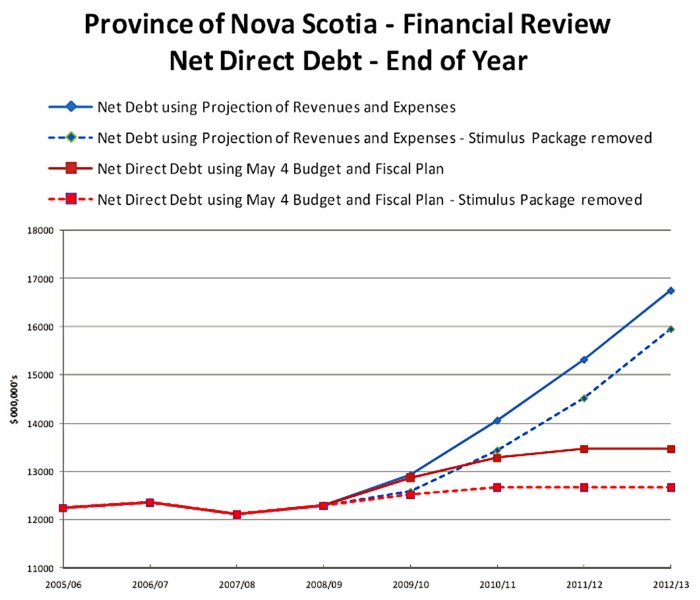
Table of Contents
Page 19
The impact of the proposed "Building for Growth – Nova Scotia's Infrastructure Plan", factoring in the benefits of stimulus, is to increase the net debt of the Province by at least $0.7 billion.
Impact of Provincial Finance Act on Net Direct Debt
Sections 76A, 76, and 78 impact the operating results calculated under PSAB which must be part of budgets presented to the Legislature.
Section 78 of the Provincial Finance Act requires that should a deficit occur it must be recovered in the next fiscal year. The definition of a deficit is different under the Act than a deficit calculated under PSAB. Section 76A excludes certain amounts of Offshore Offset revenue from the calculation of operating results.
The forecast results for 2008-2009, per the 4th May Estimates, are a PSAB surplus of $22 million (section 2.2, Chart 2 and Table D). However, Section 76A excludes $106 million of Offshore Offset revenues leaving a deficit under the legislation of $84 million, which must be recovered in 2009-2010.
The amounts of Offshore Offset revenues to be excluded in future years is the actual amount of Offshore Offset revenues up to the maximum specified in the Act with the balance of the $830 million advanced recovered in 2011-2012. The amounts forecast to be excluded over the next three years are outlined in Table S Table Q below.
Table Q: Revenue excluded for calculation of balanced budget (per Section 76A)
| Table Q |
($ millions) |
| Year |
Revenue Excluded
under 76A |
Details |
| 2009-2010 |
151 |
Actual offshore
offset revenue |
| 2010-2011 |
92 |
Amount specified
in
S76A(1)(f) |
| 2011-2012 |
298 |
Balance of $830 million,
S76A(2) |
The projected deficits under PSAB must be increased for the excluded revenues listed above, and the 2008-2009 legislative deficit recovered in 2009-2010 in order for compliance with the Provincial Finance Act. Table T Table R below illustrates the level of surplus needed in each year to comply with the section 76 of the Provincial Finance Act.
Table R: Surplus required under PSAB to comply with the Provincial Finance Act
| Table R |
($ millions) |
| Description |
2009-
2010 |
2010-
2011 |
2011-
2012 |
| Projected Deficit under PSAB |
51 |
717 |
1,075 |
Recovery of 1008-2009
Section 78 |
84 |
– |
– |
Excluded Offshore Offset
Revenues under S76A |
151 |
92 |
298 |
Surplus under PSAB
to comply with
Provincial Finance Act |
286
|
809
|
1,373
|
Table of Contents
Page 20
Some cost-shared agreements, primarily with the Federal Government, provide revenues that are to be used for the acquisition of capital assets. In order to reduce net direct debt, the surplus in any year must equal or exceed these revenues. The Province has had a practice of "restricting" the annual surplus by these amounts. The operating results for 2006-2007 and the Estimates for 2007-2008 reflected this practice. However, this practice is not legislated and requires a surplus of sufficient size to implement. Accordingly, this practice was not followed in the forecast results for 2008-2009 or the 4th May Estimates for 2009-2010 because the anticipated surplus did not equal the capital related revenues.
Summary
In assessing the future net debt levels, there is an important distinction between the surplus levels required to break even under PSAB accounting guidelines and the surpluses required under the Provincial Finance Act. Continuing to adhere to the Provincial Finance Act will create pressure to decrease expenses in the current year to recover prior year debt repayment obligation and to resume debt repayments in the current and future years. The Government should revisit this requirement in light of the serious financial management challenge facing the Province and create a revised policy approach to balanced budgets and debt management.
Table of Contents
Page 21
4. Conclusion
We have studied various financial items included in the 4th May Estimates as presented to the Legislature. As a result of this review, we have noted the following accounting, financial management, and other related highlights which were described in detail throughout the document.
Accounting
- This report is not an audit nor does it express accounting opinions. During the course of our review we found no accounting treatments that were not in compliance with GAAP.
- There is an important distinction between surplus levels defined by accounting standards7 and surplus levels required to comply with the Provincial Finance Act. The Government should revisit the requirements of the Act in light of the financial management challenges it faces.
Financial Management
- The combination of several events has culminated in the projected trend of significant annual deficits. Growth in expenses outpaces revenue gains, under status quo assumptions, into and past 2010-2013. The resulting deficits are more complex than normal cyclical deficits and more complicated than typical structural deficits would suggest.
- Recurring deficits are a result of:
- Changes in the 2009 GDP and other economic indicators resulting in a decrease in revenue forecasts.
- Additional changes in offshore offset petroleum royalties and federal equalization payments that prevent revenue growth from returning to pre 2007-2008 levels.
- Departmental expenses used in the 4th May Estimates were not based on historic departmental spending patterns. Updated expenses forecasts indicate a realistic expectation for 2012-2013 expenses to be $10.1 billion as compared to the $8.9 billion included in the 4th May Estimates.
- The impact of the proposed "Building for Growth Nova Scotia's Infrastructure Plan", factoring in the benefits of stimulus, is to increase the net direct debt of the Province by at least $0.7 billion.
Other observations
- Prepayment of University Assistance in 2008-2009 creates lower than estimated grant
payments in 2009-2010. As a result, there will be budgetary pressures in future years in order to return to conventional levels of annual assistance. New financial planning will be required to address this break in the university funding pattern that creates inconsistency with historical spending patterns.
- As surplus in the amount of $106 billion was not provided for in the 2008-2009
results in order to meet the debt repayment requirements of the Provincial Finance Act,
there is an amount of $84 billion from 2008-2009 that will need to be provided for in the 2009-2010 results in order to comply with the Act.
Table of Contents
Page 22
- The Province's pension liability is projected to increase over four years from $82 million in 2009-2010 to $198 million in 2012-2013. The related interested costs are estimated to almost double over the same period.
- We were not able to confirm the details of outstanding, unfulfilled, verifiable comments for capital spending and we have assumed all stimulus spending available has been committed.
- Offshore Petroleum Royalties comprised 5.3% of revenues in 2008-2009, but are estimated to drop to 2.3% in 2009-2010. This will have a significant impact on the Province's surplus/deficit, as included in the 4th May Estimates.
- Expenses related to Federal Intergovernmental agreements beyond 2009-2010, are difficult to predict as the estimates of future costs and federal funding is not always accurate. The figures for future years represent the amounts planned to meet the objectives under the agreements assigned; however, as spending plans are developed the provincial and federal funding amounts can change. Given the size, complexity and risks to the Province, continued monitoring of these agreements is recommended. Further recommendations to this effect will be presented under Phase 2.
- Declines in federal equalization payments present significant financial pressure to the Province given that these federal transfer payments are expected to represent 17% of all provincial revenues in 2009-2010.
As a result of compounding financial pressures, the Government of the Province of Nova Scotia must address significant spending challenges and consider the implementation of new financial policies, and adjustments to program spending.
Table of Contents
Page 23
Appendix A –
Additional review items
This Appendix will expand on four topics specified in the RFP in further detail than that which they are described within the main body of our report.
- Offshore petroleum royalties
- Federal transfer (equalization) payments
- Intergovernmental agreements
- Provisions for losses and/or bad debts
A.1 Offshore petroleum royalties
Medium term revenue forecasts to 2012-2013 are impacted from offshore petroleum royalties. Offshore royalties are a complex arrangement which is analyzed below.
Offshore petroleum royalties explained
The Province currently receives revenue in the form of royalties from the Sable Offshore Energy Project ("SOEI"), and is expected to receive royalties from the Deep Panuke Offshore Gas Development Project ("DPOG") commencing in late 2010. Royalties from these projects are administered by the Department of Energy.
SOEI commenced gas production in 2000, and is expected to be wound up in 2020, given current volume projections. The expected life of DPOG royalties has not been determined; however, volumes produced are expected to be significantly lower than SOEI.
Background
Royalties are currently calculated based on an accreting formula that is linked to various measures of the financial success of the project. Generally, royalties are set as an increasing percentage of gross revenues in early years of the project, switching to increasing percentages of net revenues in later years. For simplification purposes, under the current formula, the Province receives 30% of net revenues from SOEI (where net revenues are computed as sales revenues less operating expenses less capital outlays less an allowance for return on invested capital). We highlight that sales revenues in the formula above are impacted by the price of gas, the price of oil, production volume and foreign exchange rates. All of these factors, with the exception of production, are, of course, highly impacted by major trading markets, which have historically been very volatile. Accordingly, as offshore petroleum royalties are based on, and are therefore positively correlated with, these factors, we note that they also carry high levels of year on year volatility.
Analysis
The Henry Hub is generally seen as the primary price for the North American natural gas marketprice. For purposes of demonstrating market volatility in gas prices, we note that on July 30, 2008, the Henry Hub natural gas spot price was $9.01 per million British thermal units (mmBtu), however, one year later on July 30, 2009, the Henry Hub natural gas spot price was $3.41 per mmBtu. This represents a 62% decline in the price of gas over a 12 month period.
Table of Contents
Page 24
The Province's forecasted royalty revenues follow a similar trend: revenues in 2009-2010 are expected to decline to almost half of 2008-2009 levels. Further, downward adjustments were made to 2009-2010 figures to reflect increased capital costs due to major maintenance, as well as decreased production during the maintenance period.
Given historical correlations, as a rule of thumb, approximately 85% of gas price increases flow through to increase offshore petroleum revenues.
The following chart displays the Province's projected offshore petroleum royalties in the period from inception of SOEI in 2000 to its projected wind down in 2020 (note that royalties from DPOG have not been factored into this analysis, but are not expected to be significant over the medium term):
Chart A.1: Petroleum Royalties 2000 to 2020

It is also worthy to note that the Province may also receive revenue from license forfeitures. However, our analysis has shown that there are very few outstanding exploration licenses that are near the point of termination. Changes in government regulations have also occurred that make it easier for companies to extend and/or combine licenses, which encourages exploration. As a result, very little revenue from license forfeitures is anticipated.
Summary
- The assumptions made by the Government and the information obtained to support those assumptions appear reasonable.
- Royalties are heavily dependent on energy prices which are widely expected to continue to be volatile. This makes revenue projections from offshore petroleum royalties very difficult to estimate and predict with any accuracy.
Table of Contents
Page 25
- No significant or material revenue from license forfeitures can be expected.
- Royalties, and variations in royalties, have significantly impacted the Provinces'
revenues and surpluses from 2006 to 2009. The graph that follows shows royalties as a percentage of the Government's overall total revenue. Royalties comprised 5.3% of revenues in 2008-2009, but are estimated to drop to 2.3% in 2009-2010. This will have a significant impact on the Province's surplus/deficit, as included in the 4th May Estimates.
Chart A.2: Offshore petroleum royalties as a percentage of total provincial revenues

The 4th May Estimates projected royalty revenue of $195.9 million in 2009-2010. The most current estimate (July 2009) remains at $195.9 million.
A.2 Federal transfer (equalization) payments
Medium term revenue forecasts to 2012-2013 are impacted by federal equalization payments. These payments are highly influenced by the offshore offset arrangement and the various factors that the Federal Government includes in the calculation.
Background
Equalization payments are cash payments made from the Federal Government to the provincial Governments with the objective of offsetting differences in fiscal capacity between provinces. Equalization has been a much discussed topic among the provinces and the Federal Government, particularly since 2000.
There were a number of attempts to address these criticisms, culminating in recommendations of the Expert Panel on Equalization and Territorial Formula Financing in May 2006 which stated that, generally, for 2009/10 and future years;
Table of Contents
Page 26
"Growth in the equalization funding will now be set at the three-year moving average growth in national gross domestic product (GDP). The fiscal capacity cap is the average fiscal capacity of the equalization receiving provinces (if Ontario is an equalization receiving province).
In 2009–2010 the Federal Government will provide a transitional payment to ensure that the Province does not receive less in equalization payments than it did in 2008–2009".
The outcome of the equalization formula is relatively flat payments for six years, (2007/08 to 2012/13) with no growth and a $150 million decline in 2010/11, as illustrated in the below chart.
Chart A.3: Equalization payment revenues

- 2007-2008 to 2008-2009 – The absence of growth in these years is due to the strong performance of offshore royalties, for which the Province obtains relief under the Offshore Offset arrangement. As stated earlier in this report, and related to Equalization payments, the Province has negotiated Offshore Offset payments to compensate the Province for inclusion of royalties in the calculation of fiscal capacity for purposes of equalization.
- 2009-2010 – Equalization payments are higher than would otherwise be the case due to Nova Scotia receiving a onetime transitional payment of $150m in 2009-2010 to ensure that the Province does not receive less in equalization payments than it did in 2008-2009.
- 2010-2011 – Equalization payments decline due to removal of the transitional payment, the cap on the program, and Ontario's impact on the calculation of "fiscal capacity".
- 2011-2012 to 2012-2013 – Nova Scotia's revenue rises due to expected decreases in offshore petroleum royalties, which will result in lowering the Province's fiscal capacity and estimates of improvements in the Canadian economy increasing the available pool of federal funds for equalization payments.
Table of Contents
Page 27
Nothing came to our attention to indicate that the estimate was not reasonable or presented in a manner that was not consistent with PSAB. Since changes to the formula in 2005, Nova Scotia's actual equalization payments have equaled its estimates. As such, declines in payments as estimated above will present significant financial pressure to the Province given that these federal transfer payments represent 17% of all provincial revenues as per 2009-2010.
A.3 Intergovernmental agreements
Nova Scotia has future obligations to 2012-2013 under numerous intergovernmental agreements and programs.
Background
Our review of intergovernmental agreements focused on agreements between the Federal and Provincial Governments, which are often referred to as "cost shared agreements". Generally the cost shared agreements involve a flow of funds from the Government of Canada to the Provincial Government, with certain conditions attached, which are then used by the Province towards common priorities, goals, objectives, etc. of both governments. Given the broad range of possible goals and objectives, we highlight that there are many types of unique intergovernmental agreements.
Our review of the Province's agreements
The Province's database of agreements with the Federal Government reveals 88 agreements with Federal and Provincial obligations as outlined in the below table.
Table A.A: Summary of Nova Scotia Intergovernmental Agreements with Federal Government
| Table A.A |
($ millions) |
| Description |
2009-2010 |
2010-2011 to
2012-2013 |
Total 4 year spend,
to 2012-2013 |
| Federal Contribution |
580 |
1,220 |
1,800 |
| Provincial Contribution |
350 |
750 |
1,100 |
| Total |
930 |
1,970 |
2,900 |
Nothing has come to our attention to indicate that intergovernmental agreements were improperly or inaccurately reported in the 4th May Estimates.
It is important to note, however, that the amounts beyond 2009-2010, are difficult to predict as the estimates of future costs and federal funding is not always accurate. The above figures represent the amounts planned to meet the objectives under the agreements as signed. However, as spending plans are developed the provincial and federal funding amounts can change. Given the size, complexity and risks to the Province, continued monitoring of these agreements is recommended. Further recommendations to this effect will be presented under Phase 2.
A.4 Provisions for losses and/or bad debts
Nova Scotia's provides for losses and bad debts by government departments, agencies and funds. The analysis of this provision as at 31st March 2009 is provided below.
Background
The Government has general receivables which are amounts due to the Government, and loan programs which are administered by departments or agencies of the Government (i.e. Nova Scotia Business Inc., Innovacorp). With any receivable or loan program of this nature, there will be instances where monies due to the Government will not be paid, and a loss results.
Table of Contents
Page 28
The Government estimates in its budgets and sets aside, as an expense in its financial statements, an amount which represents its estimates of the amounts which may be unpaid or unrecoverable.
When it appears that all attempts to recover the debt have been exhausted, the Government writes off the uncollectable amounts in accordance with Section 23 (1) of the Provincial Finance Act.
Summary of our review
The current provisions seem adequate based on the nature of the receivables. However, these items will need increasing attention given the current economic uncertainties.
Other items which came to our attention
In addition to loan programs, the Government and its agencies may make loans that are forgiven if the borrower fulfills specified conditions (i.e. create and maintain a specified level of employment) within the lending agreement.
Once the set conditions are met, the receivable portion of the forgivable loan is written off and included along with the bad debts for the year. These conditional or forgivable loans are accounted for as regular loans despite the strong likelihood that they will not have to be repaid if the recipient meets the conditions of the agreement.
Under Section 23 (1), these types of conditional loans are included with all other uncollectable debts when they are written off. Consequently, borrowers who have met all the terms of their agreement with the Government are included with other debtors when write off announcements are made public following the Order of Council approvals.
The current process does not reflect the nature of the agreement and as a result it appears as though those that had entered the agreement did not pay a debt, and that the Province was unable to collect on a debt. The Province may want to consider an update to the Provincial Finance Act S. 23(1) to allow for a clearer representation and distinction of true bad debts and forgivable loans.
Table of Contents
Page 29
Appendix B –
Relevant Sections of the Provincial Finance Act
The below has been taken, unaltered, from PART IX of the Provincial Finance Act8:
Interpretation
74 In this Act,
(a) "deficit" means the amount in a fiscal year by which the total of:
(i) net program expenses and net debt servicing costs for the fiscal year as
defined in the budgetary summary of the annual Estimates of the
Province for that fiscal year,
(ii) consolidation adjustments for governmental units in that fiscal year, and
(iii) net income or losses for government business enterprises in that fiscal year,
exceed ordinary revenue for the fiscal year as defined in the budgetary summary of the annual Estimates of the Province for that fiscal year;
(b) "fiscal period" means a period of four consecutive fiscal years, with the first four-year fiscal period commencing on April 1st, 2000, and each successive four-year fiscal period commencing on April 1st next following the first year of the previous fiscal period;
(c) "government business enterprise" and "governmental unit" means those entities listed in the Schedule to this Act and any additional entities designated pursuant to section 80;
(d) "Minister" means the Minister of Finance;
(e) "surplus" means the amount by which revenues in a fiscal year exceed the total of:
(i) net program expenses and net debt servicing costs for the fiscal year,
(ii) consolidation adjustments for government services organizations [governmental units] in that fiscal year, and
(iii) net income or losses for government business enterprises in that fiscal year.
2000, c. 4, s. 71; 2004, c. 3, s. 37.
8 From PART IX, GOVERNMENT ACCOUNTABILITY
Provincial Finance Act, CHAPTER 365 OF THE REVISED STATUTES, 1989
Table of Contents
Page 30
Report of overspending
75 Where an amount is expended in excess of an appropriation referred to in the Appropriations Act, the Minister responsible for expenditures made pursuant to the
appropriation shall table in the House of Assembly or, if the House is
not sitting, file with the Clerk of the House of Assembly a report
setting out the amount of the overspending and the reasons the expenses
were required to be made. 2000, c. 4, s. 71.
No budget with deficit
76 In each fiscal year of the Province, commencing with the 2002-2003 fiscal year, the Minister shall not table a budget in the House of Assembly that estimates a deficit for the Province for the fiscal year to which the budget relates. 2000, c. 4, s. 71.
Interpretation of Sections 76 to 78
76A (1) The annual revenue, in an amount not to exceed that as set out for each year below, which would otherwise be recognized under generally accepted accounting principles with respect to the receipt of an offset payment in each year, as a result of an arrangement between the Government of Canada and the Province on offshore revenues, shall not be recognized for the purposes of Sections 76, 77 and 78:
(a) fiscal year 2005-2006 – fifty-seven million one hundred thousand dollars;
(b) fiscal year 2006-2007 – ninety-three million dollars;
(c) fiscal year 2007-2008 – one hundred eighty-nine million dollars;
(d) fiscal year 2008-2009 – two hundred seven million dollars;
(e) fiscal year 2009-2010 – one hundred fifty-one million dollars; and
(f) fiscal year 2010-2011 – ninety-two million dollars.
(2) The annual revenue, in an amount equal to no more than eight hundred thirty million dollars less the sum of all annual revenues not recognized under subsection (1), which would be otherwise recognized in the fiscal year 2011-2012 under generally accepted accounting principles with respect to the receipt of an offset payment as a result of an arrangement between the Government of Canada and the Province on offshore revenues shall not be recognized for the purposes of Sections 76, 77 and 78. 2005, c. 6, s. 30.
When deficit occurs
77 Where the Minister determines that a deficit has occurred, the Minister shall:
(a) table, in the House of Assembly or, if the House is not sitting, file with the
Clerk of the House of Assembly a report setting out the amount of the
deficit and the reasons why it occurred; and
(b) repealed 2002, c. 5, s. 50.
2000, c. 4, s. 71; 2002, c. 5, s. 50.
Recovery of deficit
78 (1) Subject to subsection (2), a deficit in a fiscal year shall be recovered no later than the end of the fiscal year next following the year in which the deficit occurred.
(2) Where a deficit occurs in a fiscal year as a result of:
Table of Contents
Page 31
(a) an expenditure required in the fiscal year because of a natural or other disaster in the Province that could not have been anticipated and that affects the Province or a region of the Province in a manner that is of urgent public concern;
(b) losses associated with a sale, dissolution, closure or other restructuring of a governmental unit or government business enterprise that are not anticipated to have a similar financial impact on future fiscal years; or
(c) an expense incurred with respect to debt servicing costs that exceeds the amount budgeted for debt servicing costs for the fiscal year,
the deficit is not required to be recovered. 2000, c. 4, s. 71; 2004, c. 3, s. 37.'
Table of Contents
Page 32
Appendix C –
Definitions of accounting terms and treatments relevant to the Financial Review
C.1 Accounting treatments
We have reviewed accounting treatments to ensure any options available were chosen appropriately. Upon the review, we note that the various items identified for study in this financial review do not have accounting options available. Accounting treatments in government can sometimes appear unusual due to their unique application of government
accounting through PSAB guidelines. However, in recent years, PSAB guidelines have moved somewhat closer to GAAP accounting.
Areas where specific understanding and clarification continues to be important include:
- Treatment of commitments made by government;
- Capitalization of capital assets and the related expensing of operating costs and amortization;
- Government transfers;
- Deferred revenue in transfer recipients;
- Accrual accounting for governments;
- Definition of surplus and net direct debt; and
- Consolidating certain government organizations and the concept of control.
Definitions for relevant items can be found later in this Appendix. Phase 2 will further address this area.
Accounting
treatment is determined by the nature of the transaction and must reflect the transaction in a transparent and meaningful way. Accounting principles that are subject to either changes in laws or the needs of special interest groups result in inconsistencies in both the principles and their application. Furthermore, bias can occur when accounting principles are selected with the interest of a particular user, economic or political objective(s) in mind. Transactions should not be designed to suit preferred accounting treatments; accounting should follow and report the nature of the transaction.
It is important that accounting policies used in the financial statements are also followed consistently in the budgets and estimates, and any variances from those policies are identified and fully disclosed, even though not all aspects of the budget and estimates are audited by the Auditor General. We encourage this practice continue to be followed by the Government of Nova Scotia.
Accounting treatments: For items reviewed in this report, accounting treatments were determined not to be subject to multiple accounting options available. The accounting applications appropriately followed the nature of the relevant transaction.
Table of Contents
Page 33
C.2 Definitions
Government transfers are transfers of money from a government to an individual, an
organization or another government for which the government making the
transfer does not:
(a) Receive any goods or services directly in return, as would occur in a purchase / sale transaction;
(b) Expect to be repaid in the future, as would be expected in a loan; or
(c) Expect a financial return, as would be expected in an investment.
1. Major types of transfers include entitlements, transfers under shared cost agreements and grants.
For purposes of this Section:
(a) Entitlements are transfers that a government must make if the recipient
meets specified eligibility criteria. Such transfers are non-discretionary in the sense that both:
2. Are prescribed in legislation and/or regulations.
3. (b)Transfers under shared cost agreements are a reimbursement of eligible expenditures pursuant to an agreement between the transferring government and the recipient.
(d) Grants are transfers that are made at the discretion of a government. The government making the transfer has discretion in deciding whether or not to make a transfer, the conditions to be complied with, if any, how much will be transferred and to whom.
4. As discussed in paragraph PS 3410.41, some transfers have characteristics of more than one of these three major types of transfers.
Surplus
The Provincial Finance Act provides the following definition of a surplus:
"surplus" means the amount by which revenues in a fiscal year exceed the total of
(i) net program expenses and net debt servicing costs for the fiscal year,
(ii) consolidation adjustments for government services organizations [governmental units] in that fiscal year, and
(iii) net income or losses for government business enterprises in that fiscal year
Net Direct Debt
The Province Debt Reduction Plan 2005 provides a reasonably clear explanation of Net Direct Debt:
"Net direct debt is defined as total liabilities less financial assets.
It is an accounting term, equal to the accumulated amount of accounting deficits or surpluses for each year, plus the investment in capital assets less amortization (the difference between these two is called the change in net book value), plus or minus changes in inventories and prepaid expenses.
In order for the net direct debt of the Province to decrease, the total surplus must be greater than the change in net book value of assets."
Table of Contents
Page 34
Appendix D – Glossary
D.1 Glossary
The following contains descriptions of terms that are used throughout this report:
-
We refer to PSAB. PSAB is the Public Sector Accounting Board and is an independent body with the authority to set accounting standards for the public sector.
- We refer to GAAP, or Generally Accepted Accounting Principles. This is a term to refer to a standard set of guidelines for financial accounting used in any given jurisdiction; in this case we follow PSAB's GAAP. GAAP includes the standards, conventions, and rules accountants follow in recording and summarizing transactions, and in the preparation of financial statements.
- We refer to 'Fiscal year'. This is a 12 month period used for calculating annual financial statements of the Government. The Province's fiscal year runs from the 1st of April to the 31st of March in the following year.
- We refer to '4th May Estimates'. These are the Province of Nova Scotia's Estimates and related budget papers as presented to the House of Assembly on 4th May 2009 for the fiscal year 2009-2010, including the Fiscal Plan to 2012-2013. The 4th May Estimates contain 'Forecasts', which refer to the expected results for the 2008-2009 fiscal year, and 'Projections', which are expected results for future fiscal years.
- We refer to 'Amortization'. In accounting terms, amortization (also called depreciation) refers to expensing the acquisition cost of an asset, minus the residual value (or remaining value of the asset once it is has been fully depreciated), in a systematic manner over its estimated useful economic life of the asset.
– Amortization is recorded as an expense in the Consolidated Statement of Operations and Accumulated Deficits.
– For example, when the Government has vehicles, the purchase price of the vehicles is recorded on the balance sheet and a portion of the cost is expensed to the Consolidated Statement of Operations and Accumulated Deficits each year of the life of the vehicle to reflect the fact that the vehicle can be used by the Government for a number of years.
- We refer to 'Structural Deficit'. Structural deficit is not a technical accounting term. The term is used in the public sector to describe the deficit that continues across fiscal years, because the level of government spending is higher than its revenues.
– For example, in a household situation, a family may find that it continually spends more than it earns each month. This shortfall, or structural deficit, is funded by credit cards or other forms of consumer debt. Additional income or reduced spending is necessary to remove the shortfall.
- We refer to 'accounting standards'. These are authoritative standards for financial accounting and reporting developed through a standard-setting process and issued by a recognized standard setting body (in this case, the Public Sector Accounting Board (PSAB)). Accounting standards specify how transactions and other events are to be recognized, measured, presented and disclosed in government financial statements.
Table of Contents
THE END
This HTML version of this document is
presented here for your convenience only.
Care has been taken to transcribe the
information accurately, but in case of
differences, the official report is the
authoritative source. Where accuracy is
important, please consult official sources.
|

