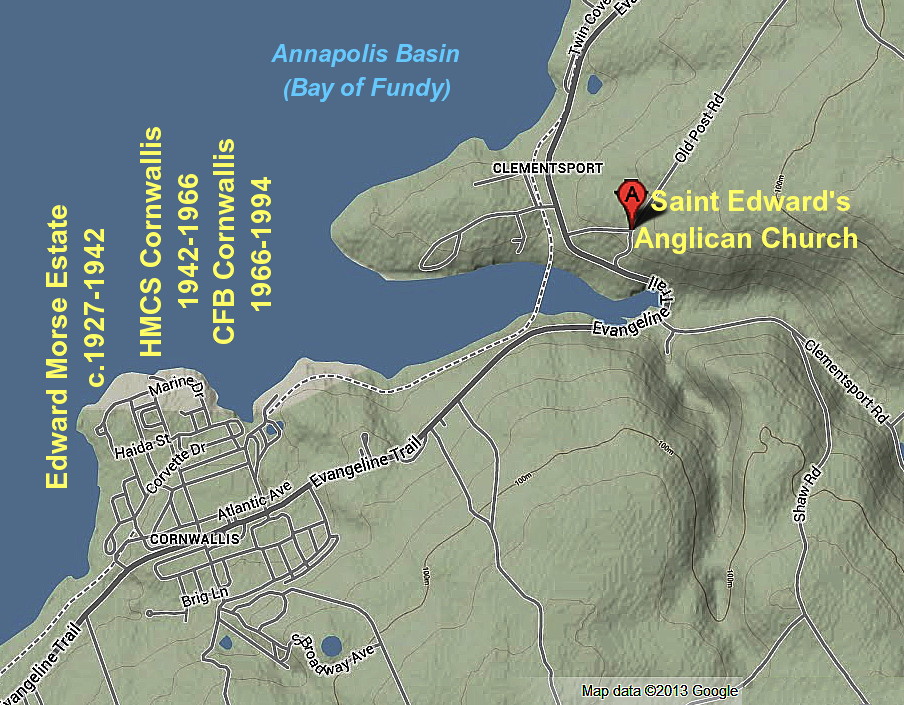
Map showing Edward Morse locations
Clementsport, Annapolis County, Nova Scotia
Located in the Old St. Edward's Anglican Church
34 Old Post Road, Clementsport
GPS location: 44°39'51"N 65°36'21"W
Google map showing this location
Saint Edward's Anglican Church
HMCS Cornwallis
CFB Cornwallis
In 1942 the Royal Canadian Navy (RCN) purchased the Morse Estate and adjacent properties to establish a new Naval Training Base (for training the thousands of new recruits being brought into the RCN during World War Two, 1939-1945) now known as Canadian Forces Base (CFB) Cornwallis.
#
Edward P. Morse (1859-1930) commemorative plaque
#
Edward P. Morse mansion as it appears in 2013
#
Morse Dry Dock & Repair Company: aerial view
#
World's Largest Floating Dry Dock
# Morse Dry Dock Dial – series published in 1918
# Morse Dry Dock Dial – series published in 1919
# Morse Dry Dock Dial – series published in 1920
# Morse Dry Dock Dial – series published in 1921
# Morse Dry Dock Dial – series published in 1922
# Morse Dry Dock Dial – series published in 1923
Maintaining Ships and Dividends
by Edward P. Morse
| cover | page 1 | page 2 | page 3 | page 4 |
| page 5 | page 6 | page 7 | page 8 | page 9 |
| page 10 | page 11 | page 12 | page 13 | page 14 |
| page 15 | page 16 | page 17 | page 18 | page 19 |
| page 20 | page 21 | page 22 | page 23 | page 24 |
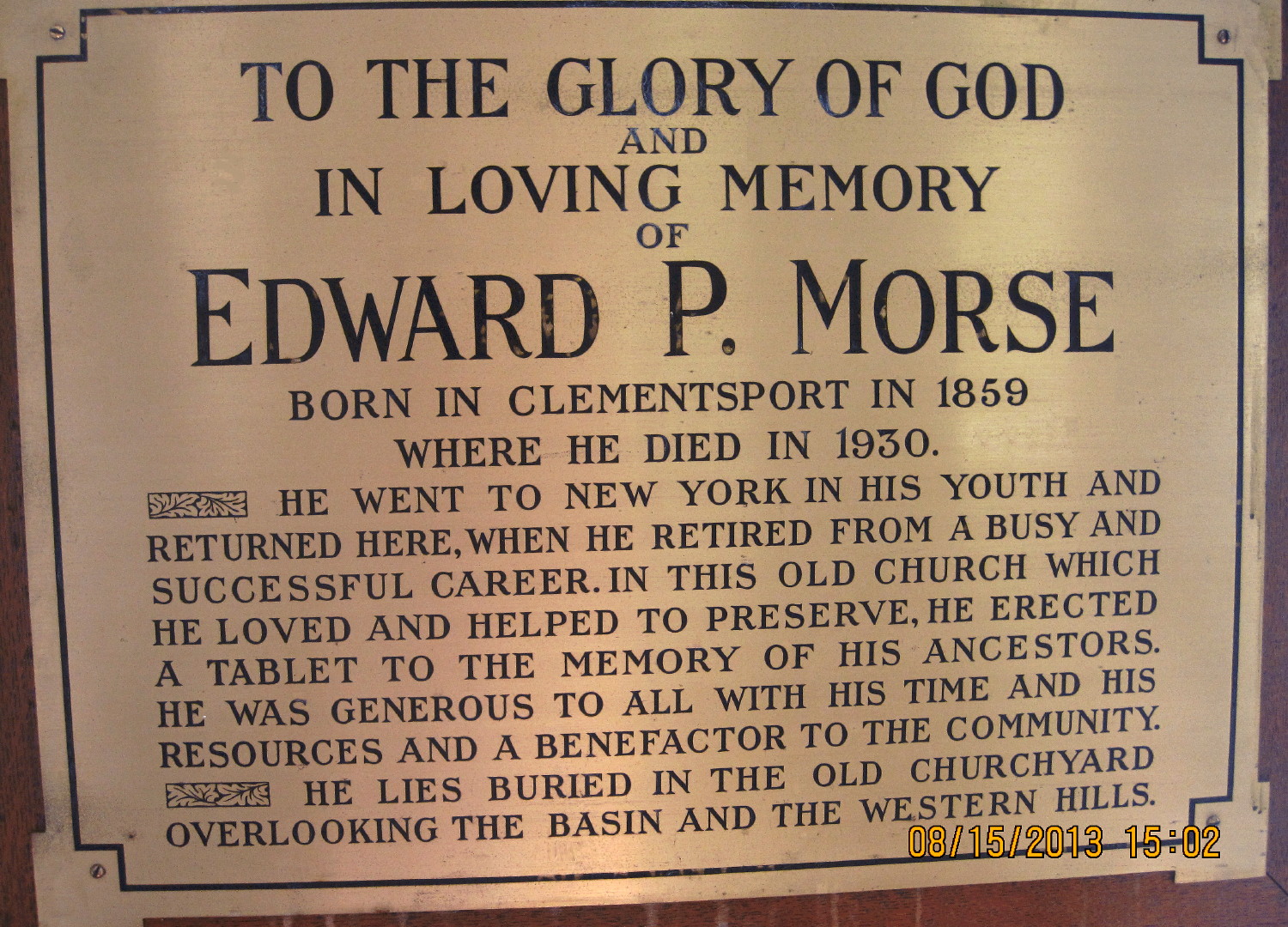
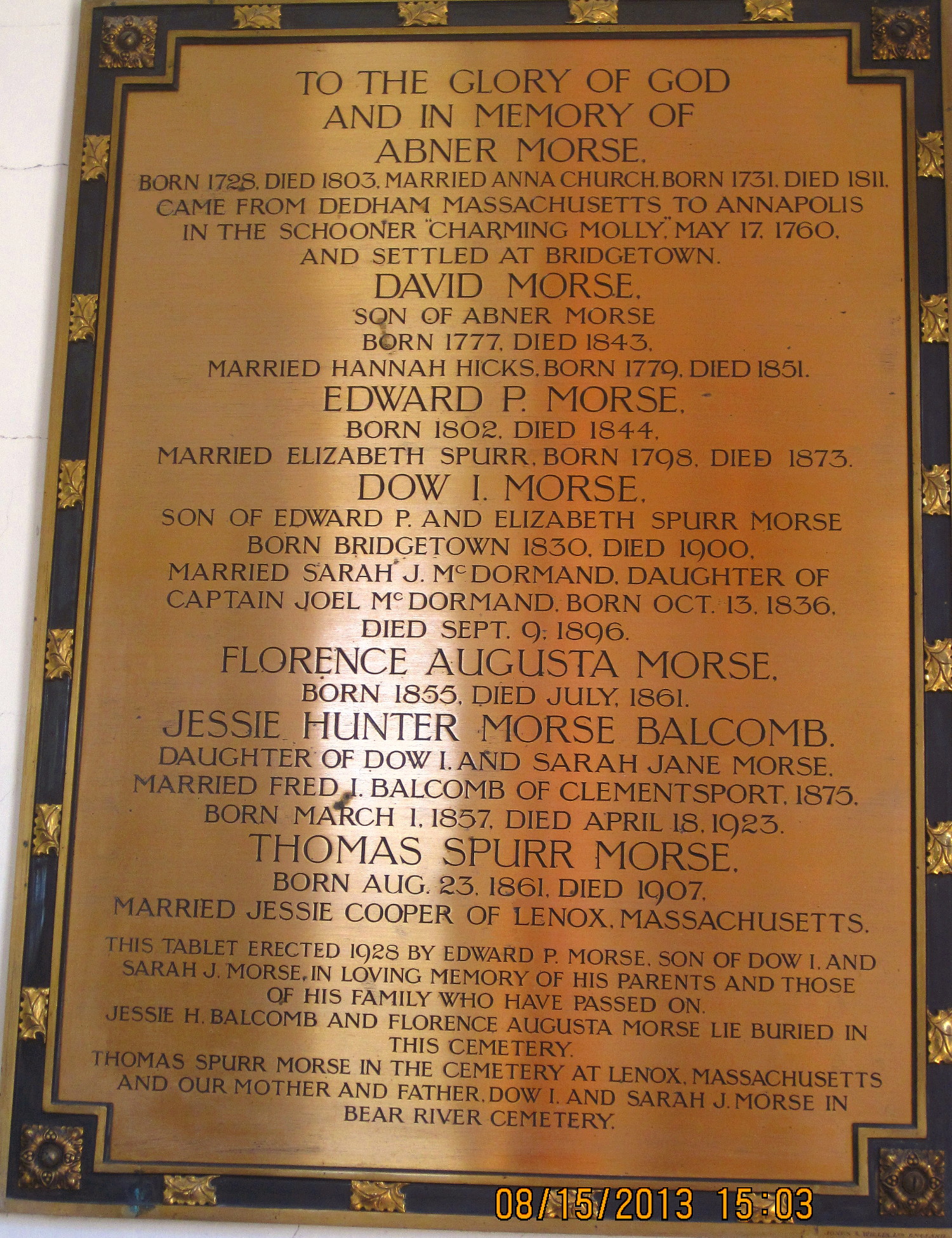
Plaques (above) photographed on 15 August 2013.
Thanks to Marilyn and Jack Wright.
|
“Abner Morse... came from Dedham, Massachusetts, to Annapolis (Nova Scotia) in the schooner Charming Molly May 17, 1760, and settled at Bridgetown...” |
|
This 1760 move by Abner Morse from Massachusetts to Nova Scotia was in response to the Land Grant Proclamations issued by Charles Lawrence in 1757, 1758 and 1759. |
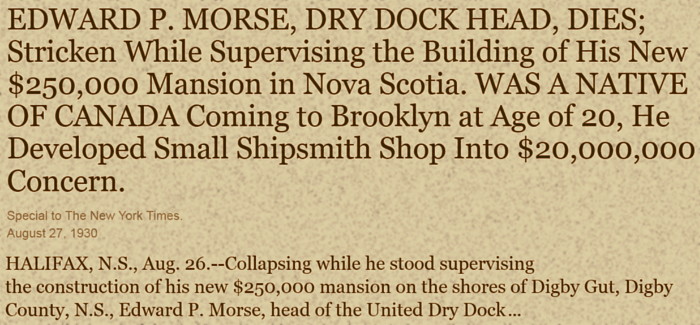
Edward P. Morse
Wikipedia
Morse Dry Dock and Repair Company
Wikipedia
World's largest floating dry dock (1919)
Wikipedia
US Navy Floating Dry Docks
World Naval Ships Forums
|
Two of the items linked above state that “three million feet” of
wood was used in the construction of the Morse Dry Dock Company's new (1919) floating dry dock. In this context, "three million feet" means three million board feet, or "three million feet board measure" (as it would appear in a legal document such as a contract or an invoice).
one million board feet = 2,360 cubic metres one foot long, twelve inches wide, and one inch thick. In other words, a board foot was (and still is) a measure of volume equal to 144 cubic inches. 144 cubic inches = 2360 cubic centimetres = 2.36 litres The "board foot" was a measure widely used for sawn lumber,and wood quantities in general (but not for firewood) in the 1800s and 1900s, continuing into the twenty-first century. Production statistics, inventories, prices of sawn timber, and other business information about wood and wood products was usually stated in terms of board feet. The term "board feet" (or "feet board measure") was often abbreviated to simply "feet", as in the items linked above. It was generally assumed that everyone understood "three million feet" of wood meant three million board feet (or 7100 cubic metres in modern language). |
|
A reasonably representative average price, in 2013
along the eastern coast of the United States, of ordinary softwood lumber when sold in large quantities, was about two dollars per board foot. At this price, the cost of three million board feet of lumber would be about six million dollars – just for the wood, at the shipping dock of the supplier. |
For shipyard magnate Edward P. Morse, the late 1910s were very good years. Buoyed by a fortune amassed during World War One (1914-1918), he constructed the world's largest floating dry dock on the Brooklyn waterfront, where his triumphs included refurbishing the USS George Washington's interiors in just 76 hours so President Woodrow Wilson could sail to the post-armistice talks in Paris. In 1919, Morse and his wife, Ada, began a breathtaking expansion of their Victorian summer house in the Long Island, New York... Morse's stables, as all his neighbors knew, housed a prized acquisition: General Ruxton, the late Theodore Roosevelt's beloved saddle horse... [links added]
—Source: Vince Camuto's Jazz Age Manor in the Hamptons Architectural Digest, July 2013
Six buildings in the great shipbuilding plant of the Morse Dry Dock and Repair Company, extending along the South Brooklyn waterfront from Fifty-fifth to Sixtieth Streets, were destroyed last night (3-4 December 1917) by a fire probably of incendiary origin... Because this plant has been employed exclusively on Government work of great importance since this country (U.S.A.) entered the war (on 6 April 1917), it has been heavily guarded. One company of soldiers has been quartered in the (Morse) yards and kept constantly on duty... The Morse docks were declared a Government reservation in September (1917), and thirty-nine saloons near it were closed by the War Department... (because) the dry dock doing Government work was in the same class as an army training camp.
—Source:
Morse Dock Plant Swept by Flames The New York Times, 4 December 1917
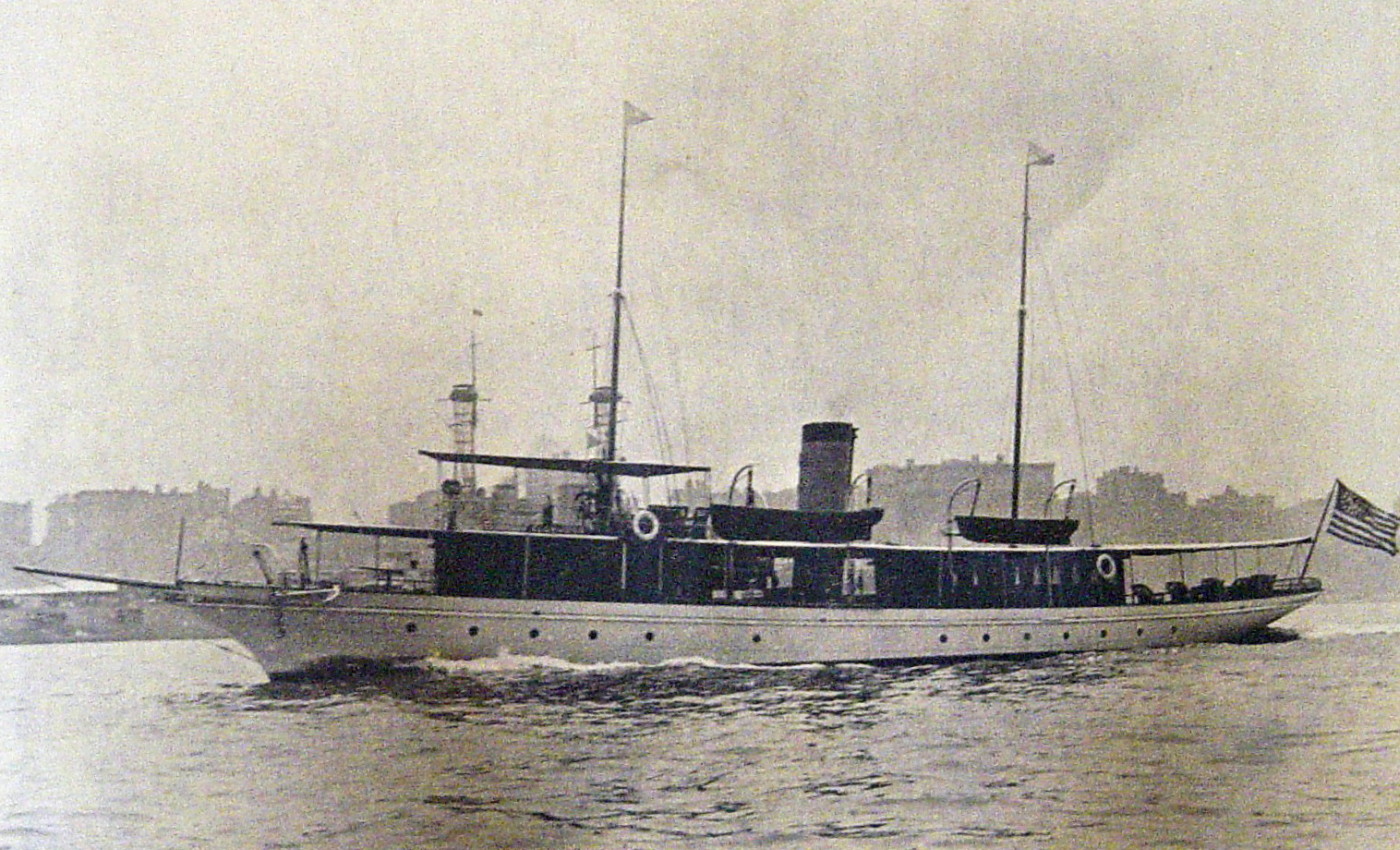
Morse Dry Dock Dial, Jan 1918 v1 n1
The Company's Growth
Hagley Museum and Library
Morse Dry Dock Dial, Mar 1918 v1 n3
Morse Company Covers Historic Ground
in Brooklyn (originally “Breuckelen”)
The property was originally the farm of Theodorus Bergen.
Theodorus Bergen was born on 17 March 1775. He was the
son of Michael Bergen and Anthe Van Wyck. Theodorus married
Sarah Vanderbilt, daughter of John Vanderbilt and Marretje Ditmars.
Theodorus Bergen died on 21 January 1859 at age 83.
Hagley Museum and Library
Morse Dry Dock Dial, Apr 1918 v1 n4
Hagley Museum and Library
Morse Dry Dock Dial, May 1918 v1 n5
Hagley Museum and Library
Morse Dry Dock Dial, June-July 1918 v1 n6
Hagley Museum and Library
Morse Dry Dock Dial, Aug 1918 v1 n7
Hagley Museum and Library
Morse Dry Dock Dial, Sep 1918 v1 n8
Hagley Museum and Library
Morse Dry Dock Dial, Oct 1918 v1 n9
Hagley Museum and Library
Morse Dry Dock Dial, Nov 1918 v1 n10
Hagley Museum and Library
Morse Dry Dock Dial, Dec 1918 v1 n11
Hagley Museum and Library
Morse Dry Dock Dial, Jan 1919 v2 n1
Hagley Museum and Library
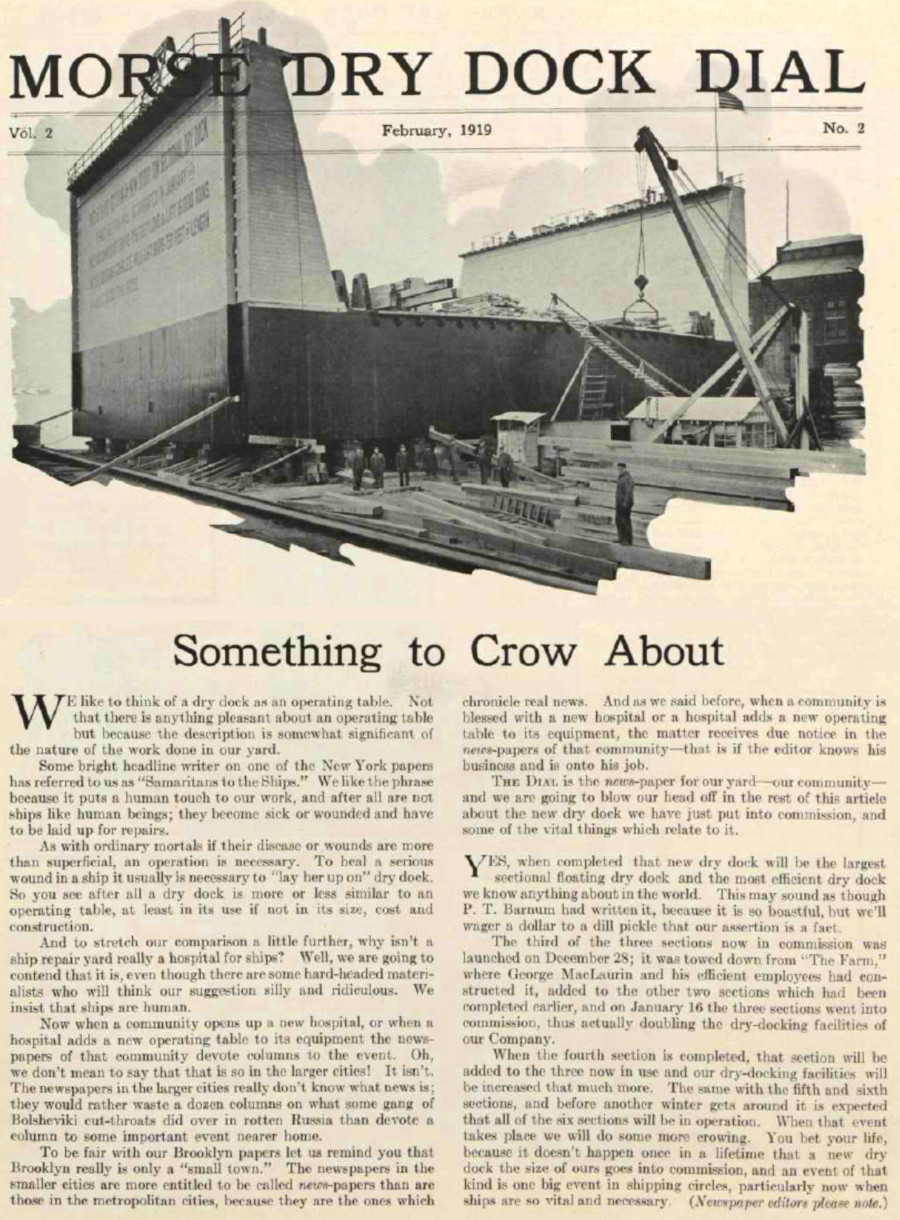
Morse Dry Dock Dial, Feb 1919 v2 n2
Hagley Museum and Library
|
...when completed the new dry dock will be the largest sectional floating dry dock and the most efficient dry dock we know anything about in the world... The third of the three sections now in commission was launched on December 28 (1918); it was towed down (from the construction site and) added to the other two sections which had been completed earlier, and on January 16 (1919) the three sections went into (commercial operation), thus actually doubling the dry-docking facilities of our Company. When the fourth section is completed, that section will be added to the three now in use and our dry-docking facilities will be increased that much more. The same with the fifth and sixth sections, and before another winter gets around it is expected that all of the six sections will be in operation... an event of this kind is one big event in shipping circles... |
Morse Dry Dock Dial, Mar 1919 v2 n3
Hagley Museum and Library
Morse Dry Dock Dial, Apr 1919 v2 n4
Hagley Museum and Library
Morse Dry Dock Dial, May 1919 v2 n5
Hagley Museum and Library
Morse Dry Dock Dial, Jun 1919 v2 n6
Hagley Museum and Library
Morse Dry Dock Dial, Jul 1919 v2 n7
Hagley Museum and Library
Morse Dry Dock Dial, Aug 1919 v2 n8
Hagley Museum and Library
Morse Dry Dock Dial, Sep 1919 v2 n9
Hagley Museum and Library
Morse Dry Dock Dial, Oct 1919 v2 n10
Hagley Museum and Library
Morse Dry Dock Dial, Nov 1919 v2 n11
Hagley Museum and Library
Morse Dry Dock Dial, Jan 1920 v3 n1
Hagley Museum and Library
Morse Dry Dock Dial, Mar 1920 v3 n3
Hagley Museum and Library
Morse Dry Dock Dial, Apr 1920 v3 n4
Hagley Museum and Library
Morse Dry Dock Dial, May 1920 v3 n5
Hagley Museum and Library
Morse Dry Dock Dial, Jun 1920 v3 n6
Hagley Museum and Library
Morse Dry Dock Dial, Jul 1920 v3 n7
Hagley Museum and Library
Morse Dry Dock Dial, Aug 1920 v3 n8
Hagley Museum and Library
Morse Dry Dock Dial, Sep 1920 v3 n9
Hagley Museum and Library
Morse Dry Dock Dial, Oct 1920 v3 n10
Hagley Museum and Library
Morse Dry Dock Dial, Nov 1920 v3 n11
Hagley Museum and Library
Morse Dry Dock Dial, Dec 1920 v3 n12
Hagley Museum and Library
Morse Dry Dock Dial, Jan 1921 v4 n1
Hagley Museum and Library
Morse Dry Dock Dial, Feb 1921 v4 n2
Hagley Museum and Library
Morse Dry Dock Dial, Mar 1921 v4 n3
Includes article:
Mr. Morse Discusses Wages And Conditions;
Must Produce More, Says Mr. Morse
Hagley Museum and Library
Morse Dry Dock Dial, Apr 1921 v4 n4
Hagley Museum and Library
Morse Dry Dock Dial, May 1921 v4 n5
Hagley Museum and Library
Morse Dry Dock Dial, Jun 1921 v4 n6
Hagley Museum and Library
Morse Dry Dock Dial, Aug 1921 v4 n8
Hagley Museum and Library
Morse Dry Dock Dial, Sep 1921 v4 n9
Hagley Museum and Library
Morse Dry Dock Dial, Oct 1921 v4 n10
Hagley Museum and Library
Morse Dry Dock Dial, Nov 1921 v4 n11
Hagley Museum and Library
Morse Dry Dock Dial, Dec 1921 v4 n12
Hagley Museum and Library
Morse Dry Dock Dial, Jan 1922 v5 n1
Hagley Museum and Library
Morse Dry Dock Dial, Mar 1922 v5 n3
Hagley Museum and Library
Morse Dry Dock Dial, Apr 1922 v5 n4
Hagley Museum and Library
Morse Dry Dock Dial, May-June 1922 v5 n5-6
Hagley Museum and Library
Morse Dry Dock Dial, Jul 1922 v5 n7
Hagley Museum and Library
Morse Dry Dock Dial, Aug 1922 v5 n8
Hagley Museum and Library
Morse Dry Dock Dial, Oct 1922 v5 n10
Hagley Museum and Library
Morse Dry Dock Dial, Nov 1922 v5 n11
Hagley Museum and Library
Morse Dry Dock Dial, Dec 1922 v5 n12
Hagley Museum and Library
Morse Dry Dock Dial, Jan-Feb 1923 v6 n1
Hagley Museum and Library
Morse Dry Dock Dial, Apr 1923 v6 n4
Hagley Museum and Library
Morse Dry Dock Dial, May 1923 v6 n5
Hagley Museum and Library
Morse Dry Dock Dial, Jul-Aug 1923 v6 n7-8
Hagley Museum and Library
Morse Dry Dock Dial, Sep 1923 v6 n9
...a call is made for specifications at ten o'clock in the morning,
bids are opened at eleven, and work started by noon...
Hagley Museum and Library
Morse Dry Dock Dial, Oct 1923 v6 n10
Special Diesel Number
The First Industrial Diesel Engine Plant in New York City
Hagley Museum and Library
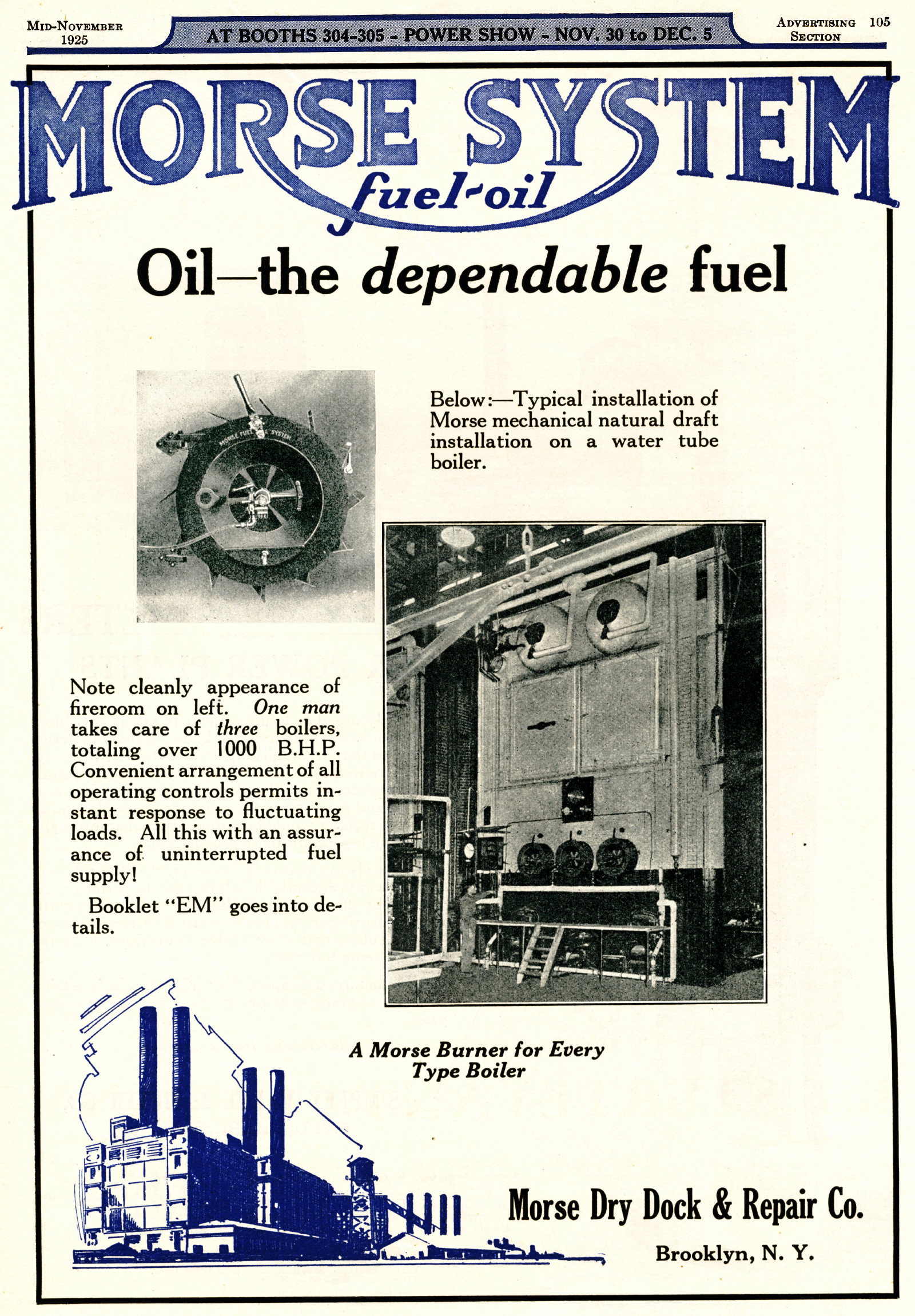
![Edward P. Morse: [cover] “Maintaining Ships and Dividends” (management philosophy) — Presentation Cover](morse-management-1920s-p00-w1500px.jpg "Edward P. Morse: [cover] “Maintaining Ships and Dividends” (management philosophy) — Presentation Cover")
![Edward P. Morse: [page 1 (front page)] “Maintaining Ships and Dividends” (management philosophy) — Title page: A Personal Message from One Executive to Another](morse-management-1920s-p01-w1500px.jpg "Edward P. Morse: [page 1 (front page)] “Maintaining Ships and Dividends” (management philosophy) — Title page: A Personal Message from One Executive to Another")
![Edward P. Morse: [page 2] “Maintaining Ships and Dividends” (management philosophy) — Foreword: A brief Discussion of the Problem of Ship Maintenance from the Standpoint of the Executive who Controls His Shipping Company's Expense and Revenue](morse-management-1920s-p02-w1200px.jpg "Edward P. Morse: [page 2] “Maintaining Ships and Dividends” (management philosophy) — Foreword: A brief Discussion of the Problem of Ship Maintenance from the Standpoint of the Executive who Controls His Shipping Company's Expense and Revenue")
![Edward P. Morse: [page 3] “Maintaining Ships and Dividends” (management philosophy) — Factors Determining whether a Repair Plant Can and Will Consistently give Ship Owners and Operators Best Economic Performance](morse-management-1920s-p03-w1200px.jpg "Edward P. Morse: [page 3] “Maintaining Ships and Dividends” (management philosophy) — Factors Determining whether a Repair Plant Can and Will Consistently give Ship Owners and Operators Best Economic Performance")
![Edward P. Morse: [page 4] “Maintaining Ships and Dividends” (management philosophy) — Convenient Location and Easy Accessibility of the Morse Dry Dock & Repair Company](morse-management-1920s-p04-w2000px.jpg "Edward P. Morse: [page 4] “Maintaining Ships and Dividends” (management philosophy) — Convenient Location and Easy Accessibility of the Morse Dry Dock & Repair Company")
![Edward P. Morse: [page 5] “Maintaining Ships and Dividends” (management philosophy) — Convenient Location of Plant of the Morse Dry Dock & Repair Company](morse-management-1920s-p05-w1200px.jpg "Edward P. Morse: [page 5] “Maintaining Ships and Dividends” (management philosophy) — Convenient Location of Plant of the Morse Dry Dock & Repair Company")
![Edward P. Morse: [page 6] “Maintaining Ships and Dividends” (management philosophy)
— Aerial View, Main plant and offices of the Morse Dry Dock & Repair Company](morse-management-1920s-p06-w2000px.jpg "Edward P. Morse: [page 6] “Maintaining Ships and Dividends” (management philosophy)
— Aerial View, Main plant and offices of the Morse Dry Dock & Repair Company")
![Edward P. Morse: [page 7] “Maintaining Ships and Dividends” (management philosophy)
— Adequate Pier and General Facilities at the Morse Dry Dock & Repair Company](morse-management-1920s-p07-w1200px.jpg "Edward P. Morse: [page 7] “Maintaining Ships and Dividends” (management philosophy)
— Adequate Pier and General Facilities at the Morse Dry Dock & Repair Company")
![Edward P. Morse: [page 08] “Maintaining Ships and Dividends” (management philosophy) — Workshops Owned and Operated by the Morse Dry Dock & Repair Company](morse-management-1920s-p08-h2000px.jpg "Edward P. Morse: [page 08] “Maintaining Ships and Dividends” (management philosophy) — Workshops Owned and Operated by Morse Dry Dock & Repair Company")
![Edward P. Morse: [page 9] “Maintaining Ships and Dividends” (management philosophy) — Scope of Shop Facilities at the Morse Dry Dock & Repair Company](morse-management-1920s-p09-w1200px.jpg "Edward P. Morse: [page 9] “Maintaining Ships and Dividends” (management philosophy) — Scope of Shop Facilities at the Morse Dry Dock & Repair Company")
![Edward P. Morse: [page 10] “Maintaining Ships and Dividends” (management philosophy) — Photograph, America's Largest Floating Dry Dock at the Morse Yards ready to be submerged](morse-management-1920s-p10-w2000px.jpg "Edward P. Morse: [page 10] “Maintaining Ships and Dividends” (management philosophy) — Photograph, America's Largest Floating Dry Dock at the Morse Yards ready to be submerged")
![Edward P. Morse: [page 11] “Maintaining Ships and Dividends” (management philosophy) — Capacity of Dry Docks at the Morse Dry Dock & Repair Company](morse-management-1920s-p11-w1200px.jpg "Edward P. Morse: [page 11] “Maintaining Ships and Dividends” (management philosophy) — Capacity of Dry Docks at the Morse Dry Dock & Repair Company")
![Edward P. Morse: [page 12] “Maintaining Ships and Dividends” (management philosophy) — Photographs, Large Ships in Dry Dock at the Morse Dry Dock & Repair Company](morse-management-1920s-p12-h2000px.jpg "Edward P. Morse: [page 12] “Maintaining Ships and Dividends” (management philosophy) — Photographs, Large Ships in Dry Dock at the Morse Dry Dock & Repair Company")
![Edward P. Morse: [page 13] “Maintaining Ships and Dividends” (management philosophy) — Dry Dock Records at the Morse Dry Dock & Repair Company](morse-management-1920s-p13-w1200px.jpg "Edward P. Morse: [page 13] “Maintaining Ships and Dividends” (management philosophy) — Dry Dock Records at the Morse Dry Dock & Repair Company")
![Edward P. Morse: [page 14] “Maintaining Ships and Dividends” (management philosophy) — Photographs, Employees at the Morse Dry Dock & Repair Company](morse-management-1920s-p14-h2000px.jpg "Edward P. Morse: [page 14] “Maintaining Ships and Dividends” (management philosophy) — Photographs, Employees at the Morse Dry Dock & Repair Company")
![Edward P. Morse: [page 15] “Maintaining Ships and Dividends” (management philosophy) — Skilled and Conscientious Mechanics at the Morse Dry Dock & Repair Company](morse-management-1920s-p15-w1200px.jpg "Edward P. Morse: [page 15] “Maintaining Ships and Dividends” (management philosophy) — Skilled and Conscientious Mechanics at the Morse Dry Dock & Repair Company")
![Edward P. Morse: [page 16] “Maintaining Ships and Dividends” (management philosophy) — Accurate Accounting for Labor and Materials used for each job at the Morse Dry Dock & Repair Company](morse-management-1920s-p16-h2000px.jpg "Edward P. Morse: [page 16] “Maintaining Ships and Dividends” (management philosophy) — Accurate Accounting for Labor and Materials used for each job at the Morse Dry Dock & Repair Company")
![Edward P. Morse: [page 17] “Maintaining Ships and Dividends” (management philosophy) — Accurate Cost Finding & Reliable Billing at the Morse Dry Dock & Repair Company](morse-management-1920s-p17-w1200px.jpg "Edward P. Morse: [page 17] “Maintaining Ships and Dividends” (management philosophy) — Accurate Cost Finding & Reliable Billing at the Morse Dry Dock & Repair Company")
![Edward P. Morse: [page 18] “Maintaining Ships and Dividends” (management philosophy) — Some of the Specialized Equipment available at the Morse Dry Dock & Repair Company](morse-management-1920s-p18-h2000px.jpg "Edward P. Morse: [page 18] “Maintaining Ships and Dividends” (management philosophy) — Some of the Specialized Equipment available at the Morse Dry Dock & Repair Company")
![Edward P. Morse: [page 19] “Maintaining Ships and Dividends” (management philosophy) — Morse Economies at the Morse Dry Dock & Repair Company](morse-management-1920s-p19-w1200px.jpg "Edward P. Morse: [page 19] “Maintaining Ships and Dividends” (management philosophy) — Morse Economies at the Morse Dry Dock & Repair Company")
![Edward P. Morse: [page 20] “Maintaining Ships and Dividends” (management philosophy)
— Photographs, Typical ship repair jobs at the Morse Dry Dock & Repair Company](morse-management-1920s-p20-h2000px.jpg "Edward P. Morse: [page 20] “Maintaining Ships and Dividends” (management philosophy) — Photographs, Typical ship repair jobs at the Morse Dry Dock & Repair Company")
![Edward P. Morse: [page 21] “Maintaining Ships and Dividends” (management philosophy) — Consistent Record at the Morse Dry Dock & Repair Company](morse-management-1920s-p21-w1200px.jpg "Edward P. Morse: [page 21] “Maintaining Ships and Dividends” (management philosophy) — Consistent Record at the Morse Dry Dock & Repair Company")
![Edward P. Morse: [page 22] “Maintaining Ships and Dividends” (management philosophy) — Competent Supervision at the Morse Dry Dock & Repair Company](morse-management-1920s-p22-w1200px.jpg "Edward P. Morse: [page 22] “Maintaining Ships and Dividends” (management philosophy) — Competent Supervision at the Morse Dry Dock & Repair Company")
![Edward P. Morse: [page 23] “Maintaining Ships and Dividends” (management philosophy) — Policy at the Morse Dry Dock & Repair Company](morse-management-1920s-p23-w1200px.jpg "Edward P. Morse: [page 23] “Maintaining Ships and Dividends” (management philosophy) — Policy at the Morse Dry Dock & Repair Company")
![Edward P. Morse: [page 24 (back page)] “Maintaining Ships and Dividends” (management philosophy)](morse-management-1920s-p24-w1200px.jpg "Edward P. Morse: [page 24 (back page)] “Maintaining Ships and Dividends” (management philosophy)")
-20131106-094.jpg "Edward P. Morse mansion at Cornwallis Park, Annapolis County, Nova Scotia, photographed on 6 Nov 2013")
Photographed on 6 November 2013
from the intersection of Haida Street and Spitfire Street
-20131106-092.jpg "Edward P. Morse mansion at Cornwallis Park, Annapolis County, Nova Scotia, photographed on 6 Nov 2013")
When Edward P. Morse died suddenly in August 1930, the exterior of this mansion – “Trail’s End,” his retirement home – was completed, but work on finishing the interior ended. The interior remained unfinished until 1942, when this property was purchased by the Royal Canadian Navy (RCN) for the establishment of a new base for training the thousands of new recruits needed to man the rapidly expanding navy in the early 1940s. At the beginning of World War Two in 1939, Canada's navy was insignificant – just 7 warships and 3,500 men. At the end of the war in 1945, Canada had the third-largest allied navy in the world after the United States Navy and the Royal Navy. This new naval training base, HMCS Cornwallis, played a crucial role in training the thousands of new recruits required.
-1942sep.jpg "Edward P. Morse mansion at HMCS Cornwallis, Annapolis County, Nova Scotia, photographed in September 1942 - Building 30: Officers Mess")
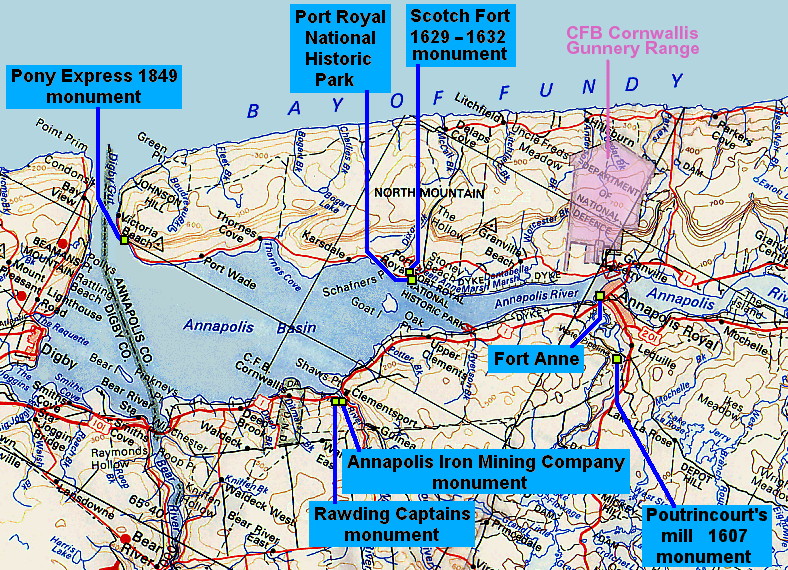
Roads are shown as they were in 1978. Except for Highway 101, the
layout of the roads in 2013 has not changed much from that shown here.
“Following the unification of the Canadian Armed Forces
in 1968, Cornwallis became the primary Canadian Forces
English-language new-recruit training centre. With the
expansion of the training course to include fieldcraft
training and firing-range practice, 3000 additional acres
were acquired at a new site at Granville Ferry on
the far (north) side of the Annapolis Basin.”
—Source:
Federal Heritage Buildings Review Office Building Report 90-320 (pdf 11Mbytes)
"Base Commander's Residence, Building 51, Canadian
Forces Base Cornwallis, Cornwallis, Nova Scotia", (page 5)
Photographs of War Memorials, Historic Monuments and Plaques in Nova Scotia
http://ns1763.ca/remem/plaques.html
 Rawding Captains monument Clementsport
http://ns1763.ca/annapco/rawdingm.html
 Clementsport war memorial Clementsport
http://ns1763.ca/annapco/clemport.html
 Clementsvale war memorial Clementsvale
http://ns1763.ca/annapco/clemvalem.html
 Bear River war memorial Bear River
http://ns1763.ca/annapco/bearriverm.html
 Fort Anne bronze cannon Annapolis Royal
http://ns1763.ca/annapco/annebroncann.html
 Poutrincourt's 1607 Mill monument LeQuille
http://ns1763.ca/annapco/lequille.html
 Arthur Kennedy tombstone LeQuille
http://ns1763.ca/annapco/kennedyja.html
 Monument: Bloody Creek 1757 Bloody Creek
http://ns1763.ca/annapco/bloodycrk.html
 1849 Nova Scotia Pony Express Monument Victoria Beach
http://ns1763.ca/annapco/ponyexmon.html
 Port Royal Habitation 1605-1613 Port Royal
http://ns1763.ca/annapco/portroyal.html
 Scotch Fort 1629-1632 monument Port Royal
http://ns1763.ca/annapco/scotchfort.html
 Memorial: Commonwealth Air Training Plan, 1940-1945 Middleton
http://ns1763.ca/annapco/bcatpww2.html
 Commonwealth Air Training Plan memorial, 1940-1945 Kingston
http://ns1763.ca/kingsco/bcatprc.html
 Bridgetown war memorial Bridgetown
http://ns1763.ca/annapco/bridgetownm.html
 Springfield war memorial
http://ns1763.ca/annapco/springfld.html
 Joshua Slocum memorial Westport
http://ns1763.ca/digbyco/slocumjmem.html
 Kempt war memorial Kempt
http://ns1763.ca/qrm/kemptmem.html
    Page View Counts
  during calendar month
     2014 Aug     50
     2014 Jul    132
     2014 Jun     42
     2014 May     38
     2014 Apr     24
     2014 Mar    552
     2014 Feb     63
     2014 Jan     51

     2013 Dec     56
     2013 Nov     85
     2013 Oct    110
     2013 Sep    145
     2013 Aug     35
First uploaded to the WWW: 2013 August 23
Latest update: 2014 September 01